

Children’s Mental Health Week

Week Beginning 7th February 2022
The 7th February 2022 marks the first day of children’s mental health week. The theme this year for children’s mental health week is growing together. A rather fitting concept and idea, in the early years we spend a lot of time supporting children’s growth and emotional well-being through our relationships, nurturing, and stimulating environments and through supporting parents/carers. Although, we should be focusing on children’s mental health all year round, heading into next week is a great time to focus on how we support children’s emotional growth, as well as their physical and cognitive growth in the first 5 years of their live.
A lot of the research around children’s mental health out there is about children over the age of 5 years old. For example, we know that 1 in 6 children between the ages of 6 and 19 years old suffer with their mental health (Anne Longfield, Children’s Commissioner 2021). This is a shocking difference to 2017 figures of 1 in 9 children suffering with their mental health, this is an issue that deserves it time, reflection, and dedication to support our children. More and more, although it is not discussed as much, I hear practitioners talking about children who are experiencing mental health problems in the early years.
So, this mental health week I am going to encourage you to take the time to reflect on your practise and consider how are we supporting the mental health of children in the early years. Especially, focusing on this year’s theme ‘Growing Together’. When it comes to emotional growth, it doesn’t stop when we become adults it is a lifelong journey, but the children do start that growth and all-important foundations when they are with us in the early years. Foundations that will be built on for many years to come. And a pivotal part of that is learning to identify, talk about and recognise our emotions.
Places2be have developed some lovely resources for children’s mental health week, focusing on growth. These can be found by clicking here. For example, using stories about growth such as the very hungry caterpillar and taking the opportunity to talk to children about their own growth from birth to now. As well as resources from previous years that can be adapted for early years settings.
We also have some resources available on our website that can help you to support children’s mental health, emotional well-being, and personal social and emotional development in the early years. You can find these in our online shop by clicking here.

National Story Telling Week
29th January 2022 to 5th February 2022
Saturday will mark the start of this years, National Story Telling Week (NSTW). Quite often when we think about story telling we think about story time, with children sat on the floor listening to an adult read a book. This is not a wrong viewpoint, however, story telling goes beyond those books that we have written down. All of us enjoy listening to stories and even telling stories, even if it is about what Aunty May did last weekend or our recent holiday.
Stories are an important part of society, for generations we have passed stories down from generation to generation, with our traditional tales or folk laws. Families full of giggles as we sit and make up stories, as we share and enjoy time with one another or the bad Dad jokes that we are all familiar with. To a child reliving their experiences and acting them out in the role-play. Or even the words of songs that tell us a story, we see ourselves in them and we apply meaning or an interpretation of that music. Story telling can come in many forms and fundamental to our culture, cognition, literacy, and language development.
Often within my role as an early year’s consultant, but also in my years of experience working within nurseries I would hear the phrase “but I am not a good storyteller”. This makes my heart heavy, because I belief that everyone in society could tell a story, be a storyteller, not just authors and acclaimed writers, or performance artists. However, I know that for some people this can be a daunting experience. This is one of the reasons I developed the online webinar, ‘Developing the Storyteller Within’. (You can find out more by clicking here).
So, with NSTW fast approaching us, it made me consider this topic again. Perhaps with a renewed excitement and passion. We all have a personal story to tell, we all tell a story each day, even if we don’t realise it. For example, “You will never guess what…”. Or the classic, “The wind will change, and your face will stay like that”. These are all the beginnings of stories, or the end of stories handed down from generation to generation. So, let’s think about the power of harnessing those stories, sharing them with children but also developing stories alongside children.
We know that story telling can support children’s senses of belonging, personal social and emotional development, communication and language development, problems solving, literacy skills, and help them to work through those difficult situations they may encounter within their lives. Although, we know the benefits to our children’s learning and development, as well as well-being it can still be a daunting task of where to start in your early years setting. With this in mind, I have shared 3 starters to developing your storyteller within alongside the children.
1. The story telling bag – this is a great activity for circle time or small group time with children to help get them involved in telling stories. In the story telling bags have different characters (e.g., people, animals, or mystical creatures) and pictures or items for setting or events (for example, photo of the beach, or fake snow). Start by taking something out of the bag and beginning to tell a story, before passing it onto a child to add to the story taking something out of the bag and continuing the story.
2. Hot seating – hot seating is a popular way of getting children who are familiar with stories to explore characters and develop narratives. One person pretends to be someone from a story and other children ask questions, e.g. “Why did you go into the 3 bears house?” This gives the children the opportunity to develop the story more and think of their own responses.
3. What happened next – start at the end of a familiar story and think about what might happen next. For example, “What happened after Goldilocks ran out of the 3 bears house?”
I hope this gives your inspiration to join in some story telling with your children for NSTW, keep your eyes peeled for our activity pack we will be realising in the next few days ‘Telling Your Story for National Story Telling Week’.

New Year, New Focus
Often this time of the year we find ourselves reflecting on the previous year and vowing to new years resolutions, change and a better year this year…

Often this time of the year we find ourselves reflecting on the previous year and vowing to new years resolutions, change and a better year this year. I will let you into a secret, I have never been very good at new years resolutions, this year I will join the gym or any of those typical resolutions we feel the pressure to make. But when I was an early year’s managers one of the things that I loved to at the end of each new year and beginning of the next was to take the opportunity to reflect. To consider how much we had achieved in the last year, the amazing moments, we have had and what is next for the setting; where do we want to go?
I am sure there are many managers up and down the country thinking about their settings, the challenges of the past years, the achievements and the where next? New year is a fabulous time to refocus to think about developing those plans for the next year that are going to help your setting grow and develop. Carefully considering the intent, why you want to do things in the next year, to support staff development, to support children’s learning and development or to focus on well-being whatever it will be. And also, the implementation how are you going to do this to ensure that you have an impact – you make a difference to your setting.
As a company we can help you to re-focus this new year to support your setting in their journey. We offer audits, hourly consultancy visits and a wide range of face to face or online continuous professional development for staff. Over 2021 it has been incredible to have met so many practitioners face to face and virtually. We are passionate as a company about inspiring practitioners and working closely with you to develop your settings to improve practise to support children and their families. We cannot wait to support more of you as we move in 2022.
We have developed a resource for you a CPD planner that can be purchased here, to help you plan out your CPD for 2022.
Happy New Year!
Pauline

Beyond Phonics: There is More to Learning to Read then Just Phonics
Often when we think of supporting or helping children to learn to read, our minds automatically go to thinking about phonics. In particular, synthetic phonics, this is where words are broken up into the smallest units…
Often when we think of supporting or helping children to learn to read, our minds automatically go to thinking about phonics. In particular, synthetic phonics, this is where words are broken up into the smallest units e.g., the individual sounds that comprise our words (phonemes) and we focus on the oral blending and segmenting of words. This is the putting sounds together to read a word but also the breaking down of words for spelling.
The emphasis on synthetic phonics was first introduced by the government over 20 years ago in 1998, alongside the National Literacy Strategy (NLS) (Chew 2018). Aiming to support literacy skills and development in the UK. And we saw the introduction of Letters and Sounds a synthetic phonics program that has been widely used in 2007, as another government documentation. With the focus of sharing an approach that would support teachers and practitioners in the UK to support children with their reading and literacy skills (DfE 2007). The structural program of teaching synthetic phonics between the ages of 5 and 7 years old is stated to be the most effective way of teaching children to read (Dfe 2013).
However, alongside a synthetic approach to phonics, we need to create a culture that understands that although research shows there is value to this approach it needs to be embedded in a much wider understanding of how children learn to read. There is more to learning to read then the simplistic skill of being able to sound out and break down words; but rather we develop communication and language skills, comprehension and a love for learning reading and books. This was emphasised by ‘The Simple View of Reading’ that demonstrates that “both word recognition processes and language comprehension need to be developed as children become readers” (Neaum 2021, p.14).

Above is a diagram of ‘The Simple View of Reading’, and ideally, we want our children to be in the top right quadrant to be the best readers that have both compression skills and word recognition processes. This means that alongside our systematic synthetic phonics approaches that we use in the Early Years Foundation Stage (EYFS) and Key Stage 1 (KS1), we also need to develop a language rich environment and curriculum.
It is also important to remember that children’s literacy development and learning goes beyond the classroom or even before they start school. Through the development of their spoken language, developing a phonological awareness, an understanding of print around them within their environment and also as they interact with technology, for example, recognising the Morrisons logo, or knowing that says Peppa Pig. As well as additional physical and sensory skills that are developed from an early age before children are ready to read. For example, a child is playing with a balloon, and they are batting it backwards and forwards with you. They are physically tracking that balloon and its movement; this tracking skill is needed for when they begin to track the words across a page when they start to read. This all begins before children start school and is beyond simply learning the sounds that our a, b, c’s make, successful readers come from developing an understanding of a balanced approached to learning to read and write.
Do you want to find out more about the topic beyond phonics and learning to read in the early years foundation stage? We have an upcoming webinar on this topic that you can click here to book your space now.

Why I don’t Like Using Emoticons
A blog post that explores why I do not like using emoticons while working with children. Find out more here.

I was having a conversation with someone the other day and I was sharing my dislike for using emoticons with young children. Firstly, I want to say this is a personal preference that I have as an early year’s teacher. Now don’t get me wrong, I love to use emoticons in text messages or an informal way as I communicate with friends and family. However, when working with children I steer clear of using emoticons. Even though it might feel cool, hip and relevant to children in modern times.
The main reason for this is that as children are learning to explore and understand their emotions, emoticons can cause confusion to them relating emotions to themselves. This is because when we use emoticons to display emotions such as sad, angry, happy, confused, shocked or surprised; it doesn’t necessarily relate to what emotions look like in us. It is much more relatable for young children to see those emotions in a photograph or mirror that can help them relate that make to their own feelings and emotions. Making it more powerful and relatable to those young minds, to portray what it might look like to feel those feelings in our body.
One of the most important things that we do in the early years is supporting children in learning to identify and understand those big and small emotions that we all experience. Part of doing this is relaying that it is natural and human for us to experience a vast range of emotions and to see these in other people. For example, how often do we catch ourselves saying things such as “I can see your feeling angry right now. That your firsts are clenched and your face is screwed up. What could we do to help you?” Understanding how our bodies react to emotions and facial expressions is vital so that we develop empathy, but also an understanding of other people’s emotions once we have learnt to understand our own.
We know that only 7% of communication and language is verbal, the rest of how we communicate is non-verbal, our body language, our facial expressions and our tone of voice. Therefore, we need to support children in being good communicators and a big part of this is understanding body language and facial expressions, talking about it with our children and exploring them in a realistic way. So this is my main reasons for not using emoticons for children.

World Nursery Rhyme Week: The Intent of Nursery Rhymes
10th -14th November 2025
World nursery rhyme week is here again. It is a fantastic opportunity to celebrate nursery rhymes in early years settings. To remember centuries worth of history, past from generation to generation that supports children’s learning and development. This blog posts explores the intent (why) behind singing nursery rhymes in early years settings with a particular focus on supporting speech, language and communication development, but also the question of quantity verses quality.
Why do we sing nursery rhymes?
Over the years research and our professional knowledge has shown many benefits to singing nursery rhymes with children. These are things such as:
Supporting young children’s communication and language development.
Increasing children’s vocabulary.
A strong link between nursery rhymes supporting communication and language development and early literacy development.
Helps children tune into rhythm and rhyme in nursery rhymes that is an important part of early phonics skills.
Research has shown that children who know 8 nursery rhymes by the age of 4 years old are some of the best readers by the age of 8 years old (Meme Fox, Reading Magic).
Can support all areas of cognition, for example, learning to recite numbers through number rhymes.
Can help build children’s self-confidence.
Supports attachments and emotional well-being in babies and young children as they bond with caregivers whilst singing rhymes together.

A pack of 7 carefully planned nursery rhyme group activities to support children’s learning and development. With clear instructions and outlines of what is needed to run each simple fun and engaging session. Each activity has a a bit of a twist on the way that you would normally sing the rhymes to make them fun and engaging for all.
The Impact of Speech Language and Communication Needs
Nursery rhymes are proven to support communication and language development, increasing children’s understanding of language and also their vocabulary. Now more then ever we are seeing children start early years settings with a speech and language delay. NHS England (2019) states that “18–31% of children aged 19–21 months living in disadvantaged communities have language delay that warrants referral for specialist assessment.”. Additionally, NHS England (2019) states that 50% of children starting school from a socially disadvantaged background start school with a language delay or a Speech Language and Communication Need (SLCN). Additionally, research published by Speech and Language UK (2023) suggests that 1 in 5 (20%) children struggle with talking and understanding words. This is 1.9 million children in the UK! And that 80% of teachers feel that children are behind in talking.
This shows now more then ever the importance of focusing on nursery rhymes in the early years to support children’s SLCN, as part of a language rich curriculum. As well as supporting all children and going above and beyond to narrow the gaps in our societal inequalities based on social economical status. We can additionally see the long term impact of children being delayed in speech and language development. For example, Speech and Language UK (2023) report states the following staggering statistics, that children who are being in talking and understanding are 6 times more likely to be behind in English at age 11, 11 times more likely to behind in maths and twice as likely to be unemployed as an adult.
Here is a recorded version of our webinar, ‘Before I Can Write’. For individuals or teams to watch together as part of your continuous professional development. There is the opportunity to pause for discussions or self-reflection within the webinar. This recording has been made for those that have wanted to attend a live event but have not been able to.
This webinar explores how we cannot simply force children to write, before they are ready to learn to write there are many skills that they need to develop. This includes their communication and language, physical skills and imagination. This webinar begins to introduce some of the skills children need before they can write.
Quality Verses Quantity
Meme Foxe, statement that children who know 8 nursery rhymes by the age of 4 years old are some of the best readers at the age of 8 is very encouraging when we think about how much children need to know in order to achieve. This is also highlights the point that it isn’t about quantity of singing rhymes, but actually the quality of the interaction with those rhymes and supporting children’s communication and language development through singing nursery rhymes.
This is reassuring for those of us that have ever felt the pressure, when we sing the same nursery rhymes over and over again in our setting; because they are the children’s favourites! But feeling like we have failed because we are singing again, baa baa black sheep or twinkle twinkle chocolate bar! Although as adults or practitioners we might feel exhausted or tired of the same old rhymes again, repetition is actually really important to young children’s learning and development. The more children repeat an action or activity the stronger the connections (synapses) in their brains come between that all important information.
We also know that when introducing new vocabulary to children with stories it is more beneficial for them to have the same story 3 times with the new vocabulary, then 3 different stories over the week with the same vocabulary. Children who have had the same story actually show a greater use and comprehension of the new vocabulary then their peers. (Raikes et al, 2006). I think that when we think about introducing nursery rhymes to children the same principle applies. It is much better to focus on one new rhyme at a time, then trying to learn the same vocabulary through many different rhymes. So be bold, don’t be scared of diving deep into those nursery rhymes. Don’t be afraid to sing the same one again, again and again.

An activity pack filled with ideas of supporting the nursery rhyme 5 little men in a flying saucer and STEM (Science, Technology, Engineering and Mathematics) in the early years. Created by a passionate early years teacher.
Blog post updated on 11/11/2025. Please do leave us a comment with your thoughts.

Alan’s Big Scary Teeth
A blog that explores how you can extend the popular story Alans Big Scary Teeth with young children.
This is a fantastic book to explore with children in the early years, especially for those children who are animal fanatics. You can take this book in many directions, as you think about a fun-loving alligator who loves to scare, with his big scary teeth. Part three of our oral hygiene series explores, how we can use this beautifully illustrated book, bound to make children laugh to promote good oral hygiene in the early years. Alan is an alligator with a secret, his teeth they are in fact false teeth. Alan wakes up one morning and has lost his teeth, can he still be scary without them? We are going to explore some ways you can use this story within your setting and tell it in a fun and exciting way, with extension activities.
Make a Story Sack
In the early years story sacks are a great way to engage children and keep them focused as you tell a story. They don’t have to be expensive, or shop brought, think about making a home-made story sack and collecting your own items to go alongside the book. For example, using a crocodile and animal puppets, having pretend teeth or false teeth for the children to see and touch and a book with your sack. Having story sacks prepped and ready to go for different books can help you in the busyness of the day (when you might not have time to gather everything for your story) but may also inspire yourself or your team in another way.
Tell the Story in a Sensory Way
Engaging all of children’s senses or using a couple of different ideas to engage senses within storytelling, helps to promote brain development, learning and help children to focus.

To download a PDF copy of this document for only £1, please click here.
Do you want to find out more about sensory story telling? Why not join out webinar, sensory story tellers in the early years? Click here to find out more.
Clean Alans Big Scary Teeth
As an extension of this story, you can have a go at cleaning Alans’s teeth afterwards. Simply use false teeth (or laminated pictures of teeth) and mark make on them with a whiteboard pen. Then use a toothbrush, toothpaste, and water to brush all the marks of the teeth.
Mirror Play
Can you scare as well as Alan? Set up some mirrors and pictures of people pulling scary faces and see if you can practise pulling a scary face just like Alan in the mirror. It is a great opportunity to talk with children about what makes a face scary and identify the different features of our faces. Children can also look closely at the teeth, eyes, and facial features. You can also incorporate some ICT by taking photos of each other pulling scary faces and add them to the display.
Another mirror play activity you can do is mark-making with toothpastes and toothbrushes on a mirror. This is great for developing children’s gross motor and fine motor skills, sensory development, and interest in making and exploring marks.
Keep an eye out for our next blog to find out, more books that you might use to promote oral hygiene in the early years.

Using Your Curriculum to Promote Oral Health in the Early Years
This is part two of our blogs on oral health and the revised early years framework. In this blog we are going to focus on how we can use our curriculum to support oral health in the early years. So firstly, let’s consider what do we mean by curriculum? In its simplest terms our curriculum is what we want children to learn. This includes the programme, methods, and activities that we choose to implement our curriculum; to ensure that children meet the learning intention highlighted in our curriculum.
So, let’s consider – what do we want children to learn about oral health within the early years? It might be that you choose to base these on statements within development matters or birth to five matters. Or it may be that you want to come up with broader terms, such as those below.
“Our curriculum is designed to support teaching and children learning about oral health through a play-based and hands-on curriculum. We want children to learn about how to look after their teeth and the importance of good oral hygiene. Our curriculum is designed to support children’s learning and development in a holistic way, so that they develop good routines around oral hygiene and a healthy relationship with food. As a setting our curriculum embeds learning and developing oral hygiene through our everyday interactions and routines, as well as our short-term and long-term planning. “
Below are a few ideas of what you might be interested in doing as activities or experiences as part of your curriculum to support oral health in the early years:
1. Singing songs about brushing teeth and practising the circular motion that we use as we brush our teeth by doing actions.
The toothbrush on the teeth goes round and round,
round and round,
The toothbrush on the teeth goes round and round,
all day long.
(To the tune of the wheels on the bus)
2. Sharing books and stories about going to the dentist (keep an eye out for our upcoming blog ‘Review of Top Ten Books to Promote Oral Health’)
3. Tuff tray play -brushing fake teeth or small world animals’ teeth using toothbrushes and toothpaste.
4. Draw on plastic blocks with whiteboard markers and use a toothbrush and toothpaste to clean of the marks.
5. Get children familiar with the circular motion of brushing teeth big style, using those gross motor skills using toothbrushes to mark-make in shaving foam, coloured sand and paint.

6. The egg experiment – boil eggs and pop them in different fluids for a few days, for example, coke, coffee, milk, water, juice, and squash. Talk about how the outside of the egg is like the enamel of your teeth, observe and talk about what has happened to the enamel and what those different things do to our teeth.
7. Make an interactive display showing and measuring out how much sugar is in different common foods and drinks.
8. Encourage children to join in cooking and making healthy snacks and foods and talk about the benefits of the different foods to our health.
9. Heuristic play – all types of brushes basket. For toddlers and preschool children consider extending heuristic play by having a brush themed basket. For example, hairbrush, toilet brush, pastry brush, toothbrush and so on. As children explore the basket it gives you the opportunity to open discussion about purpose and function of different objects.
10. Have a dentist or dental nurse come and visit your setting and talk about their job role.
Do you want to find out more about the revised framework, your curriculum or pedagogical approach? You might be interested in some of our upcoming webinars below:
· Understanding Your Curriculum
· The Relationship between Pedagogy and Curriculum
Keep an eye out for our next blog in our oral health in the early years series…

Promoting Good Oral Health in the Early Years
September 2021 brought with it the introduction of the New Revised Framework in the Early Years. This has included a new requirement to the safeguarding and welfare requirements to promote good oral health of children. This does not mean overnight we are expected to become dentists or that we should be checking children’s teeth, however there are many ways that we can support children’s oral health.
September 2021 brought with it the introduction of the New Revised Framework in the Early Years. This has included a new requirement to the safeguarding and welfare requirements to promote good oral health of children. This does not mean overnight we are expected to become dentists or that we should be checking children’s teeth, however there are many ways that we can support children’s oral health.
Currently with the UK tooth decay in children costs the NHS (National Health Service) over £40 million a year (Guardian, 2020). This has become a huge burden on the NHS, but also, we can see a growing inequality amongst children from different social economic backgrounds. For example, The Child Dental Health Survey (2013) discovered:
“Children in more deprived areas have higher levels of tooth decay and are less likely to brush their teeth at least twice daily.”
Therefore, some settings, especially those in more deprived areas are deciding to opt into a supervised toothbrushing scheme. However, the introduction of promoting good oral health, does not mean it is compulsory for early years settings to participate in supervised toothbrushing. When considering whether you are or are not going to participate in supervised toothbrushing, I think it is important to reflect on the following questions:
· What would be your intention behind doing supervised toothbrushing?
· Do the sessions that your setting offer, fit in with being able to offer the toothbrushing scheme? (For example, 9-12 or 9-3 settings may struggle with this).
· How would you practically implement the supervised toothbrushing scheme?
· What would be the desired impact of children within your setting participating in the supervised toothbrushing scheme?
If as a setting you do decide to participate in a supervised toothbrushing scheme you can find guidance here on supervised toothbrushing in covid-19. You can also find PHE (Public Health England) guidance – Improving Oral Health: a toolkit to support commissioning of supervised toothbrushing programmes in the early years and schools’ settings by clicking here.
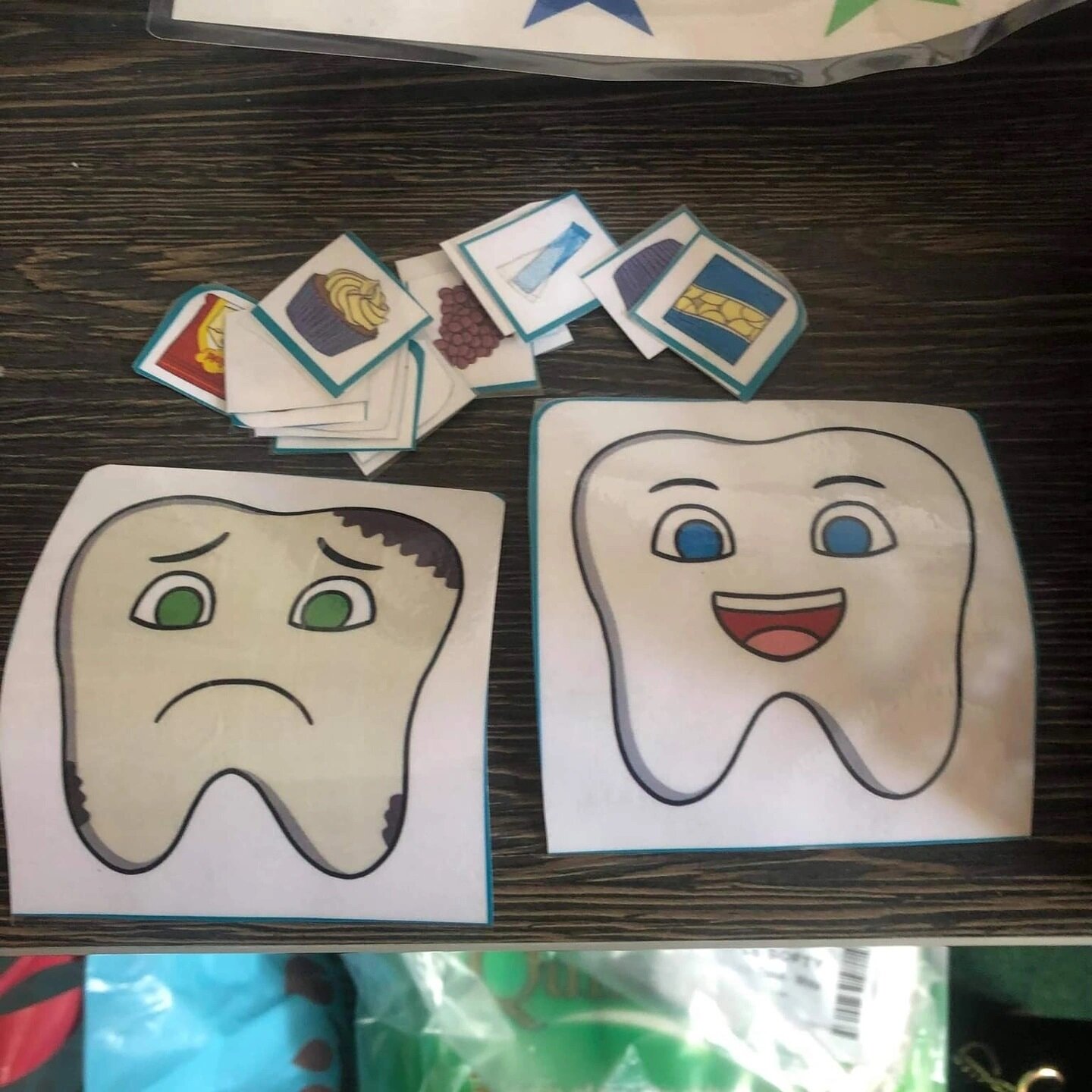
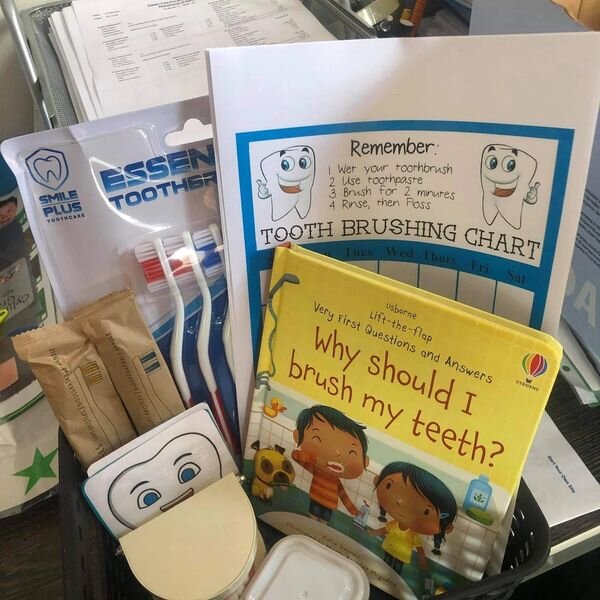
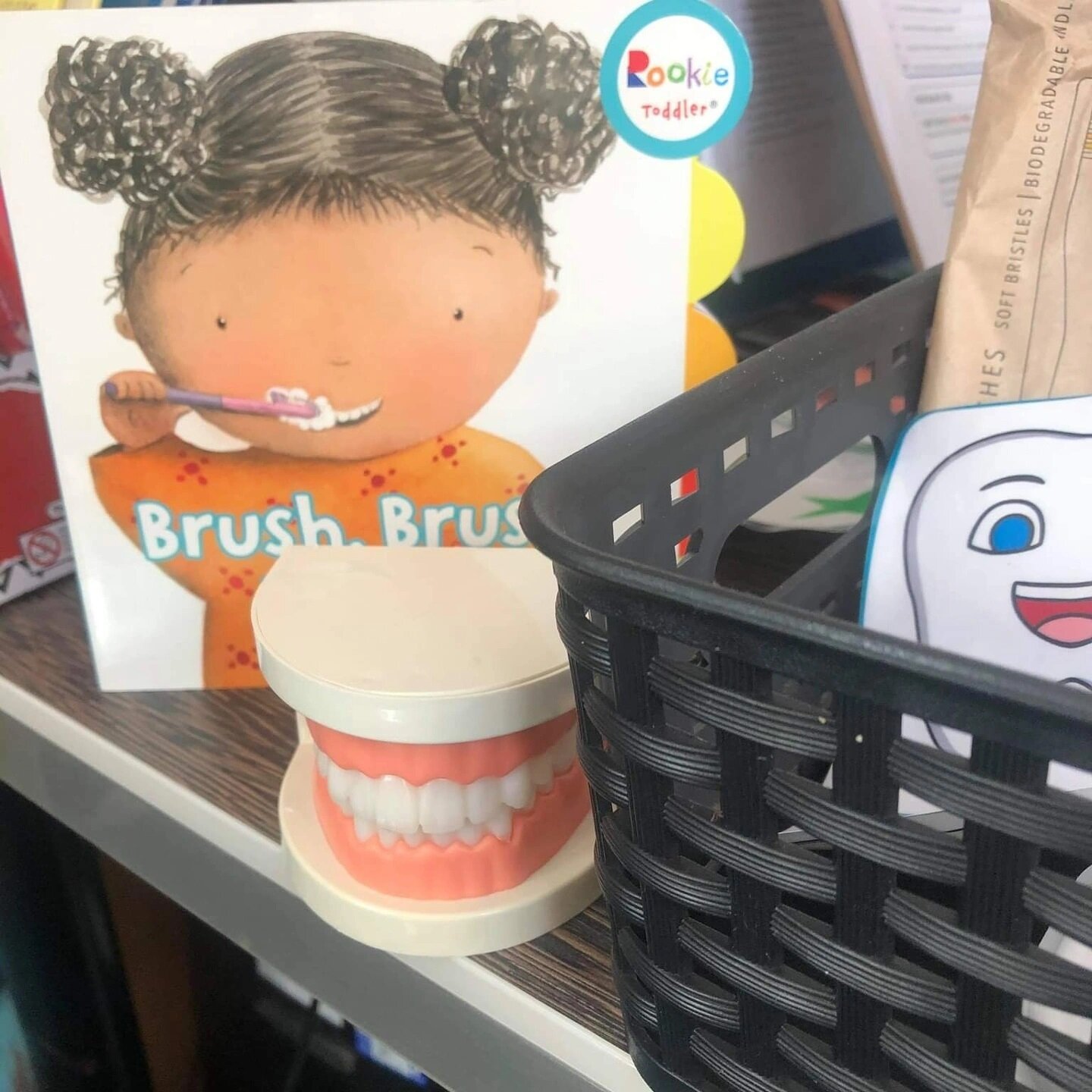
An image of the oral health home learning basket created by Lisa Brown at Happy tots Preschool in Ipswich.
Supervised toothbrushing is not the only way as early years practitioners that we can promote oral health for our children. Parental engagement and support are going to be so important as we get the messages out about good oral health. Through things such as the picture above where we have a home learning basket on the subject, story sacks, leaflets or activities sent home. To parent workshops focusing on good oral health and nutritional diets.
As early years settings we also have a responsibility to promote healthy eating and choices with children and one of the ways that we do this is through offering children a balanced diet that meets their nutritional needs. There is a very useful document that you can find here, with example menus for early years settings to ensure that we are providing a balanced diet for those children in our care.
Finally, we can use our curriculum (what we want children to learn), to help support children’s understanding of oral health from a young age. From providing specific activities, experiences and extending children’s cultural capital. Keep your eyes posted for our next blog where we discuss specific activities, ideas and provocations for promoting oral health with young children.

Embracing Schemas
“Thomas tips the basket of pom poms on the floor that you have just picked up for the 10th time in the last 30 minutes, your body sighs involuntary as you turn to assess the mess. You smile at Thomas, as he says “again, again” and begins to eagerly pick up all the items and place them back into the basket. Giving you a cheeky point counting as you throw them back into the basket. Thomas eagerly copies throwing the small pom poms.”
“Thomas tips the basket of pom poms on the floor that you have just picked up for the 10th time in the last 30 minutes, your body sighs involuntary as you turn to assess the mess. You smile at Thomas, as he says “again, again” and begins to eagerly pick up all the items and place them back into the basket. Giving you a cheeky point counting as you throw them back into the basket. Thomas eagerly copies throwing the small pom poms.”
Schemas are repeated patterns of behaviour that children do in their play. These are vital and important to child development and how children make sense of the world. Sometimes schemas are the things that exhaust us, such as a basket being tipped on the floor for the 10th time. Or the things that parents will complain about the most for example, “Joshua just keeps throwing toys” or “Sophie has to line all the toys up before we can play with them!” The thing is the more we try to squash a child’s schema, not only is it nearly impossible for that child, but also the more likely we are going to see them exhibit those behaviours.
What we can do though is we can embrace these wonderful schemas of children. We can plan for those individual learning needs, embracing the holistic child and everything we know about them. Planning isn’t just that matching everything carefully to a learning objective from development matters or birth to five matters. (Which remember is not meant to be a tick list!).
So, let’s think about our Thomas a little bit more. What do we know about Thomas?
“Thomas regularly goes to the park with his parents, and they say how he particularly likes climbing up the stairs to the slide and going down. And shows little interest in the other apparatus at the park such as the tunnels, or balance toys. He also quite often likes to sit at the top of the stairs by the stair gate and post his toys down the stairs through the stair gate. At nursery you have noticed that Thomas will spend lots of time tipping boxes out and watching the items fall. He also loves to draw and will draw straight vertical and horizontal lines across the piece of paper.”
This suggests that Thomas is learning through play in the trajectory schema this is showing an interest in the movement of himself and items and often throw toys. So, what possible things could you do or set up within your environment to support Thomas in his learning and development?

Coloured chick peas and cardboard tubes a great activity for exploring the trajectory schema.
1. Explore ramps and gradients with the toy cars, trucks and trains.
2. Have soft items that he can throw and explore the trajectory of, for example, fabric squares, pom poms, soft balls, feathers.
3. Target games with bean bags where you can introduce shape recognition and number recognition.
4. Playing with scarfs and ribbons on a windy day.
5. Using gross motor skills to walk and move along vertical and horizontal lines.
6. Mark making with cars.
7. Lots of mark-making opportunities using different medians, e.g., chalk, pencils, crayons, pens or charcoal.
8. Making kites and playing with them on a windy day.
9. Have different size cardboard tubes for children to post objects through, for example, rice, chickpeas, pom poms.
10. Opportunities to climb on apparatus.
These are simple activities or extensions that you can have within your enabling environment to support and embrace the schema that Thomas is currently in.
To find out more about the Trajectory schema, why not book on our webinar ‘Focus on the Trajectory Schema’? Or if you want to just have a general understanding of schemas, why not download our recorded webinar, ‘Again, Again, Again: Schema’s in the Early Years’?
Early Years Managers - Let’s Talk Staff Meetings
Whether it is a weekly, monthly, half-termly or termly meeting; does the term staff meeting fill you with dread that makes you want to hide and curl up in a ball? Staff meetings can be an effective way of building upon your team relationships, sharing updates, concerns, and information with a lot of people all at once. But from my experience as a manager, they can also be, incredibly hard to get all staff to attend and very quickly become a negative experience or activity that just feels everyone with dread.
So, how do you get the most out of your staff meetings. Here are some tips from my experience as an early year’s manager.
1) Have a timed agenda – have an agenda that is shared with staff prior to the meeting with timings for how long different activities will take. Try and involve staff members, for example, could the designated safeguarding lead do the safeguarding section. Involve the team as much as possible so that they don’t have to just listen to you for an hour or an hour and half.
2) Food – whether it is ordering a pizza, having a home-made chilli or plenty of sweets and crisps, I used to find a team that eat together work well together. And also, it is a token of extreme gratitude to feed them when quite often these meetings happen in the evening outside of their working day.
3) Continuous professional development – ensure that staff meetings always discuss CPD, whether that is someone feeding back about a course that they have been on. Or it is doing an activity with a CPD focus, such as, using our key point discussion cards that you can find here.
4) Set ground rules – e.g. no mobile phones, how we expect people to talk to one another.
5) Pay your staff for their time – recognise that staff are coming outside of their working hours and ensure that you show how grateful you are for their commitment by paying them.
6) Be confident and assertive – it is okay to say, “Thank you Tina for bringing that to my attention. I would like to explore this more but don’t think now is a time. Let’s meet tomorrow and discuss it just us!” It can be very easy to have the feeling within a staff meeting that you as the manager are being ganged up on, but it’s okay to revisit at a more appropriate time. And remind staff that you are available all the time, so we don’t need to save issues up for a staff meeting to be discussed, which sometimes then just escalates a problem that would not have been a problem dealt with at the time.
7) Stick to your time – after a long day at work with then a staff meeting and early day the next day. Trust me, no one wants the staff meeting to run over. So be realistic about how much you can cover in your designated time.
8) Comfort – do you have enough adult size chairs for staff? Are they going to be comfortable as you sit around? We have all done meetings on baby chairs, with tired limbs and aching legs as we try to focus and listen, feeling almost impossible. Comfort is key do you have some adult size chairs, or could you use a different room somewhere, where everyone will be more comfortable.
A Message From One Of Our Regular Webinar Attendees

Photo Credit: Glenn-Carstens-Peters on Unsplash
“Hi , my name is Natasha, I work in a early years setting, I have attended a number Pauline’s webinars (Growing Together). The webinars cover a range of subjects and they are perfect to fit in with your lifestyle. I have shared lots of information with colleagues and its great to update and refresh knowledge. Pauline shares the course material with you so you can return back to it when needed.
Diving Deeper Into Goldilocks and The Three Bears is perfect for a language enriched environment, gives you practical tips, advice and ideas and also great to participate in webinar. Great for tuff tray ideas, story mapping and also the children get deeply involved and it’d fun and exciting for them. It is such a fantastic way to connect with others virtually during these strange times, I highly recommend Pauline’s webinars 100%.” A recording of this webinar can now be purchased here.
Check out more of the adventures of Natasha and her wonderful Team on their Facebook page, just click here. It has been a pleasure to work with so many practitioners like Natasha, we are loving running online events and I also love seeing images and photos of ideas within your settings. Thank you for sharing Natasha.
If you want to join Natasha in her exploration of our new webinars, which we are continuously adding to and revolving why not check out our online shop here for our online training. We aim for our webinars to be interactive, engaging, easy for practitioners to fit around their busy lives and short enough that you don’t feel like you are giving up hours of your time. We also try very hard to relate all our webinars back to practice and creative ideas.
We have also listened to attendees or potential attendees who would like recordings, because you cannot attend the live event or perhaps you want to listen again. So, as we discontinue our older webinars and add new ones we are adding recordings the early years practitioners section of our online shop, you can find this here.

Natural Transient Art in Early Years Settings

(Photo Credit: Glenwood Family Centre)
This blog posts explores what is transient art and some of the origins of transient art. It also, looks at the why (intent) behind transient art, how it can benefit children’s learning, development, and well-being. As well as starter resources for early years settings to begin to evolve your practice into the journey of transient art.
What is transient art?
Transient art is the use of loose parts or natural objects to make art that is ‘moveable’ and not permanent. It can be evolved and developed over time. It allows children to embrace the process rather than the product. As well as being able to continuously develop and grow their ideas, think of new ideas, reflect, and change their art piece.
How can you draw on famous artists to influence your practice or study with children?
Both Andy Goldsworthy and Richard Shilling are famous nature artists, who make arrangements with natural materials (or what we might coin the phrase natural loose parts). They produce wonderful and beautiful made pieces out in nature and are highly inspirational for those of you who want to explore natural art using loose parts. Providing books, photos and posters of their work can help to promote and inspire children. Additionally, you could introduce I.C.T. skills as you research and find out about these different artists.
Why is participating in transient art beneficial to learning, development and well-being?
Both Goldsworthy and Shilling recognise the importance of nature art and the benefit of taking the opportunity to connect with nature. Nature Connection is to sound a little bit corny the relationship that we have with nature, just like we have a relationship with one another. Our connection with nature is important to our well-being, Richard Louv goes as far as to say that children are now suffering with something he has labelled a nature-deficit disorder. Simply because in everyday life and society, we have lost that connection with nature, which is having a detrimental effect on well-being. So, promoting space and opportunities to be outside and connect with nature, now more then ever is so important to our well-being. To find out more about nature connection and well-being in the early years, click here to book on our next running of our webinar.
Joining in the process of transient art can help to build children’s confidence and resilience. It is believed that there is less pressure of getting it right or wrong, but also children are not doing anything permanent. Therefore, if they are not happy with something then they can easily undo it and start again, or simply rearrange items.
As children explore transient art it can help support all areas of development and learning. From exploring positioning, making arrangements, patterns, symmetry, working cooperatively with others, exploring their own ideas, building on ideas, adapting changing. Communicating with others to share ideas and thoughts, talking about texture, shape, size, and differences in natural objects. Creating simple representations and giving meanings to them, the learning opportunities are literally endless.
Starter resources for introducing natural transient art to early years settings.
So, what do you need to start collecting resources to create an amazing area outdoors or indoors with natural items to give children an opportunity to participate in transient art. My first advice would be to get parents and staff involved…can they collect items when they are out and about on their walks?
Things such as:
Fir cones
Acorns
Pinecones
Leaves
Feathers
Coloured petals from the floor
Sticks
Pieces of fallen bark
Moss
Stones and pebbles
Shells
Bamboo circles
Straw
Wood shavings
Sometimes some children find it helpful to have a photo frame or stick frame to create their image in.
If you want to find out more about using loose parts in your setting why not join our webinar, ‘Loose Parts More Than Just a Fad’ on the 13th May 2021 at 7:30 pm.

(Photo Credit: ST Teresa’s Nursery)

Taking Earth Day Beyond One Day
The world recently stopped and celebrated Earth Day on the 22nd April 2021. Perhaps, more then ever we have realised the delicate ecosystem of our world around us as we have more time then ever to appreciate the wonders of our natural world. This year I saw many posts and early years settings joining in the celebrations of earth day. From inspiring tuff trays, to sharing books, to recycling centres role-pay areas or a special litter pick in aid of Earth day.
I also saw the counterargument to this! Yes, we live in a world where people always must give a negative from where people said, children should not be burdened with the responsibility of these things. Or too they are too young to understand. However, I feel as a sector we need to talk to children about looking after our planet in an age-appropriate way. And these children are our future leaders, and I don’t think they are ever too young to start learning simple ways to look after their world.
It made me smile to see so many settings, celebrating earth day with their children. With so many potential ways that we can support an understanding for looking after our world. So here is the question, how can we take it beyond that one day a year?
At one setting I worked with we set up a little group that was run alongside a parent and we had a group of children that represented the setting and were our eco warriors. We took the opportunity to share ideas of how we can look after our planet and make plans together of what we wanted to do in the coming weeks. For example, the children always choose to go into town for a litter picking activity (we loved going litter picking!!!). Check out some more ideas below:
The 3 R’s: Reduce, Reuse and Recycle
1. Placing coloured bins in your preschool/nursery rooms – at one setting I worked at we used to have a coloured bin system. Green bins meant recycling and children could pop things such as cardboard, yogurt pots (cleaned) and paper inside. And a red bin that was for food waste that was compostable and a blue bin for waste that needed to go in the general rubbish bin. Obviously, depending on your county and how they collect recycled materials might impact on the bins you have, but this was an easy quick win. With lots of discussion opportunities of where to put their rubbish.
2. Reuse yogurt pots and recycled materials to make instruments – Use recyclable materials to extend children’s learning. For example, using yogurt pots to make shakers for music time and cardboard boxes with elastic bands for mini guitars.
3. Tuff tray sorting recycled materials – Set up a tuff tray that will help children to define the properties of materials and sort objects for play recycling bins. Great for when they are learning what can and cannot go in a recycling bin.
4. Michael Recycle – I love this book. It is a fantastic book for introducing recycling to children in nursery, preschool, and reception.
5. The journey of a plastic bottle – A more in-depth non-fiction book that talks about the processes a plastic bottle goes through to be made.
6. Consider cutting down the amount of single used plastic you use – Perhaps a member of staff can become your settings ecowarrior and they can look at things such as how much one-use plastic you use as a setting and alternative product.
Becoming Litter Warriors
1. Duffy’s Lucky Escape – A story book for young children that explores the dangers of plastic in the ocean to animals. Beautifully written and will make your children want to go and clear up their local area to look after the animals.
2. Litter picking – Pop it in your diary to go for a litter picking trip in your local area. Or join in large community planned litter picks as a setting. Or be brave and be the organisation that organises the community litter pick!
3. Plastic in the ocean awareness - Making posters or pictures with plastic that would be recycled to raise awareness of plastic in the ocean.
Reducing Energy
1. George saves the world by lunch time – A lovely book that explores lots of simple easy little things you can do at home or in setting to save the world by lunchtime. One of my favourites.
2. Switching off electrical items – Make sure that plugs and lights are turned of when they are not needed on.
3. Pegging washing on the line with children – Pegging washing on the line will not only save lots of electricity from being wasted. By joining the children in they will be developing their fine motor skills pegging and in my experience doing everyday things with children like pegging washing on the washing line always leads to the very best conversations!

The Why Behind Our Playful Phonics Series
We have now 5 different phonics webinars for phase one to three phonics in the letters and sounds framework. These are:
· Overview to Phase One Phonics
· Taking Phase One Phonics Outdoors
· Taking Playful Phase Two Phonics Outdoors
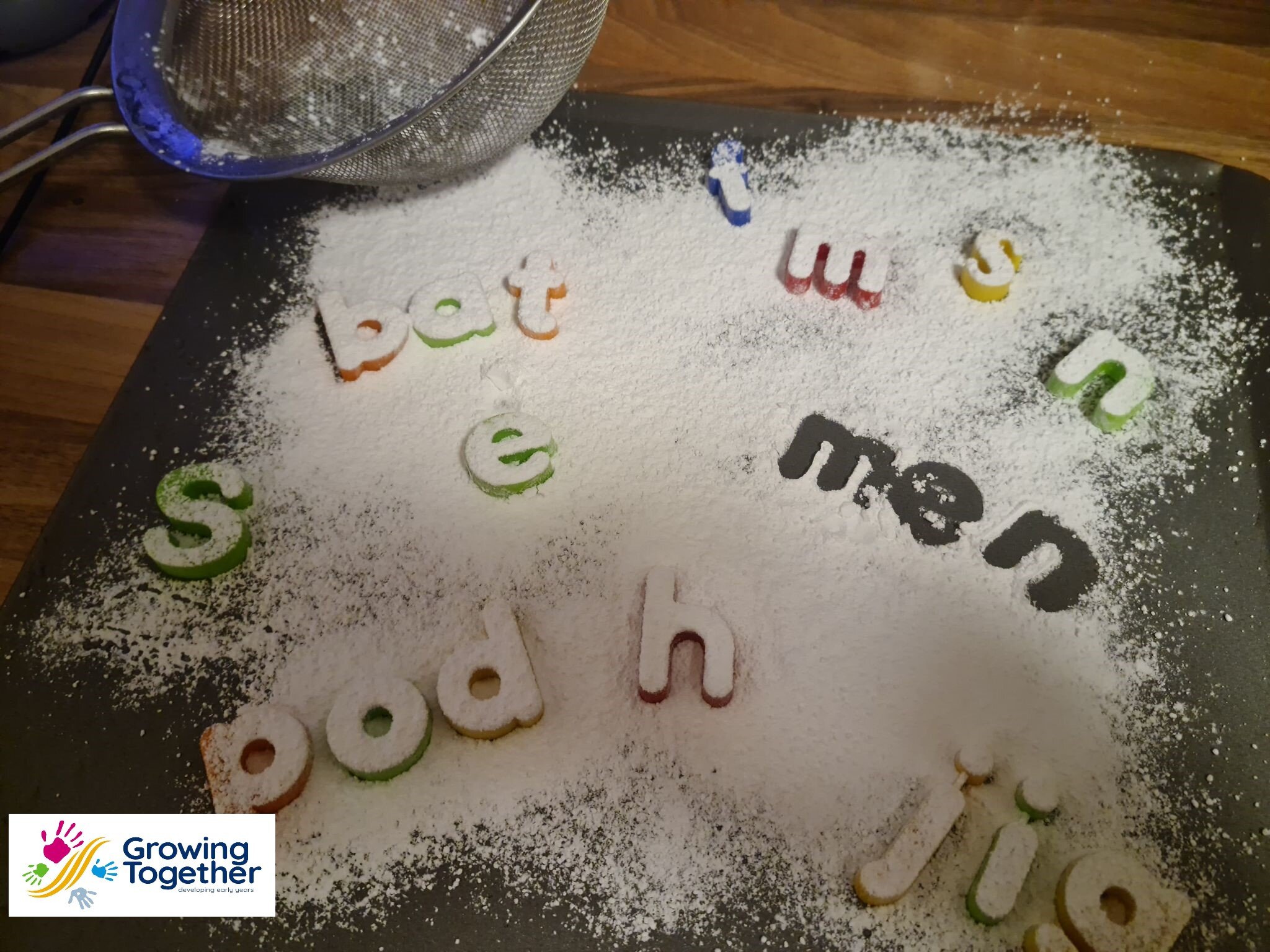
Build words using magnetic letters on a baking tray and then use a sieve to dust them with icing sugar.
So why have we based these sessions on covering phase one to three in a playful way?
As a company we believe that in play young children show the highest form of learning, there is no such thing as just play! But rather play is a vehicle of learning, allowing children to achieve far beyond where they currently are. Vygotsky can be famously quoted for saying that “Children are always a foot taller than themselves in play”. One of my all-time favourite quotes, because play can naturally extend, or scaffold children’s learning and they often show higher levels of learning in play.
So, although we cannot make phonics play in its truest form. As true play is child-led, open-ended and without predetermined outcomes. And we all know a phonics session always has a learning objective and intention that we are hoping the children will get from the session! However, we can make phonics playful, which will benefit the children’s learning and development, by supporting engagement, recognising children are hands on their learning and learn through active experiences.
I love this quote from Playful learning (2021) “Playful Learning is the magic that takes place when you mould a child's natural sense of curiosity with thoughtfully planned learning experiences.” I am true believer that within our day-to-day provision and planning of phonics that this is what we can achieve we can plan a carefully throughout approach to phonics, based on our knowledge of our children and their interests, which will enhance that playful curiosity to learning.
Additionally, through being playful we can tap into children’s natural curiosity and motivation to learn about the environment and the word around us. We know that children learn through hands-on experiences and through exploring and making the sense of the world throughout all their senses. So are playful phonics series involving lots of tactile experiences, experiences that enhance children’s auditory sense, as well as their proprioception and vestibular sense.
So, if you want to find out more and join in our playful phonics series why not check out our online training here.

Grapheme (letter) hunt in flour, rice and chick pea mixture.
Written by Pauline Milsted
(Director of Growing Together)

Guest Blog - Appointing a Family Support Practitioner in our Preschool
A guest blog from Lisa Brown about the appointment of bringing in the role of a family support practitioner at their preschool.
I contacted a colleague recently who was sharing with me how they secured funding to appoint a family support practitioner in both their preschools that she managed. I found this story a fantastic example of practice and going the extra mile with our families and children we work with. I am so delighted that Lisa agreed to write this blog to share what her settings have been up to. Thank you Lisa.
Becoming a Family Support Practitioner by Lisa Brown
This Year we have been very lucky to secure some funding from the Ipswich Opportunity Area (IOA) to invest in a family support worker to support families within the setting during the coronavirus crisis. We have also just found out the funding will be extended into next year.
I was the manager of 2 preschools and when this opportunity came up and discussions with the committee and the other manager, we decided I would move into the family support role. While she would move into the day-to-day management of the setting and I would take on the family support role and become the business manager of the settings.
I have always wanted to do this role and could not wait to get started. So far, I have supported families with food parcels, counselling support, some clothes for children and lots and lots of home learning. Including name writing resources or positional language or if a parent wants resources for something in particular.

An example of an individualised home learning pack.
I have sent questionnaires out to parents asking for what support they need so I can look into providing this. I have also been working with the children to offer them support to understand feelings and emotions using craft materials. This has been a huge success with some children and has really enhanced what the setting can offer to children. I have made over 100 tailored to the children’s needs packs to support an area of learning for children to work on at home. This can be from WELL COMM the speech and language tool or from the EYFS areas of development we also wok on the same things in setting which I do with the children on a daily basis.
The role has really supported the families and given them an extra level of support when needed as children and families have really suffered this year during the pandemic. The feedback has been they have someone to turn to if only just for a chat or help to fill out a form or help to access food, clothing for a child or help with a child’s learning and development.
Written by Lisa Brown

Brakey Woods… We are Back!
Monday 29th March 2021 finally arrived, it feels like it has been a long wait to see our friends to meet and to have fun in the woods. Lockdown, feels like it has gone on forever and today Growing Together Developing Early Years, welcomed back our Brakey Wood: Parent and Nature Group. And if I may so say myself what a wonderful session the first one of 2021 was.
The sun was shining, the birds were singing, the ladybirds, worms and even a red velvet mite we found and out in force. Children were playing, parents were nattering, coffee was drunk and even hot chocolate (and no one seemed to mind Pauline forgot to pick up the cake – I promise to make it up to you next week!). To quote a dear friend Debbie Duck (my forest school inspiration – well one of them) ‘the wind was blowing and blew away the cobwebs of our souls’.
Just what we needed in these uncertain times, I chance to be social, to connect with each other, to connect with the wonders of the environment around us. To see the changes of the woodlands since we were last there in December, to smell the smells of spring, to see the budding trees. To see our children carefree, smiling and laughing, playing, learning, and having fun.
We did ketchup bottle painting, squeezing those bottles and exploring marks was a great opportunity to build on our gross motor skills and develop the muscles in our hands as we squeezed the bottles. We shared books, played with playdough, built relationships, explored natural objects, we explored our natural environment. It is fair to say that learning was in abundance.
I wanted to share with you, why did a launch our parent and child and nature group. It is not about the money, although obviously we are a business, but it is because I wanted to nurture the connection children and families have with nature. Richard Louv in his book ‘The Last Child in the Wood’, talks about how our children and society is suffering from a nature deficit disorder. This is because we have lost our connection with nature and it affects all three aspects of our well-being, physical, emotional, and social.
Our nature connection is something valuable, it is the relationship we have with the world around us with our natural environment. It is something that I believe really needs to be nurtured, watered, and supported to grow. It is vital to our health and well-being and now more then ever this is a priority. This is my priority with our group to help develop children and family’s connection with nature, which will help nurture resilience, critical thinking, autonomy over learning and relationships with others.
I cannot wait for our next session on Easter Monday, we will follow on the children’s interests in bugs. We will celebrate Easter and go on an Easter egg hunt. To book your space now please click here.


How to Write Quality Observations in the Early Years
Some of the questions that we often get on our webinars we run the role of observation in the early years and using observations for planning are:
· What makes a high-quality observation?
· Do we have to do a written observation?
· How many observations should we do in a week or a term?
So, below we intend on discussing these questions in a little bit more depth, from my perspective as a previous manager in the early years. What was I looking for quality wise in observations? So, what does make a high-quality observation, what are we looking for? Let’s look at two examples, of observations written for the same activity and of the same child.
Observation One:
George enjoyed playing in the sand today. He played with his friends and made sandcastles. He counted stones as he put them into the sandcastle.
Assessments: Characteristics of Effective Learning – Shows particular interests, maintains attention and focus on an activity of their choosing. Personal, Social and Emotional Development: Making Relationships – 30-50 months: keeps play going by responding to what others are saying and doing. Mathematics: 30-50 months: Uses some number names accurately in play. Recites numbers in order to 10.
Observation Two:
George was playing in the sand today, alongside a group of 4 other children. George filled the bucket up with dry sand and T helped him. They took it in turns as they were filling the bucket. Once the bucket was full George turned over the bucket and tapped the bottom of the bucket. As he pulled the bucket of all the bucket up the sand spread out into a little pile. R turned to them and said, “You need wet sand!” George replied, “oh, okay I will get water!” George climbs down the steps to the sand pit, using alternate feet, while holding onto the fence with one hand and the bucket in the other hand. He runs over to the water butt in and out of objects and other children negotiating space. He twists the tap on using his left hand, filling his bucket up. He tries to twist the tap of but is struggling. He turns to the adult and asks, “Can you help me please?” The adult responds and turns the tap off. George smiles and says, “thank you!” before picking up the bucket by the handle with both hands and walking carefully around other children and objects with his bucket of water.
He tips the bucket over the edge of the sand pit, pouring the water in. And says, “Here you go!” Before, again holding onto the fence with one hand as he climbs back up the steps into the sand pit using alternate feet. George, T and R begin to fill up the bucket again. And George asks, “do you think this will work?” R replied, “yes, I do it with my daddy”. And T says, “you have to squash it down!” George says, “Okay, I will push it down!” and pats the sand down in the bucket with his hands between spades full of sand. Carefully, George and T tip over the bucket together. All three children then tap on the back of the bucket before R carefully lifts it off. George smiles as he looks at the sandcastle and says, “Wow! Great!” He then picks up the bucket and walks around the sandpit, reciting numbers as he puts stones into the bucket. All 3 children then begin to decorate the sandcastle with the stones George has collected. He pushes 3 big stones in the top and says, “Look I have 3 big stones!” R says, “We could stick a twig in as a flag” and George replies “Okay.”
Assessments: Characteristics of Effective Learning – Shows particular interests, maintains attention and focus on an activity of their choosing. Personal, Social and Emotional Development: Making Relationships – 30-50 months: keeps play going by responding to what others are saying and doing. Mathematics: 30-50 months: Uses some number names accurately in play. Recites numbers in order to 10.
Responsive planning: I joined in with George, R and T and we made more sandcastles. I modelled counting small sets of stones as we built sandcastles. And encouraged George to physically move a stone as he counted that one.
Planning ahead: Collecting more items such as shells, glass pebbles, fir cones and wooden numbers for the sand pit to continue to extend this play.
Setting up a loose parts tray inside with tweezers, small items and numbered sandcastle cards to practise counting small sets of objects.
High quality observations are objective, that describe the facts that are seen, free from subjective viewpoints and opinions or prior knowledge, focusing on everything within that moment. For example, observation one is subjective, we are making that assumption from knowledge we hold about the world that George is enjoying playing in the sandpit. However, observation 2 shows how the child is playing in the sand and is more objective, based on the facts and details that we can see in front of us. Observation 2 is an observation that is off higher quality.
High quality observations are relevant and useful, they provide a level of information that give us knowledge of children’s learning, development and interests, but also their stage of development. We are often asked the question of how many observations should you do a week or a term? And my response is a simple one, you should only do observations if they are relevant and useful. There is no thick and fast rule about how many; don’t get me wrong I have worked for companies over the years who have set that base amount one per child per week, or two per child per week. But over the years as a manager I learnt that there is not a universal amount, it is not about how much is in a child’s learning journey, but rather how do we use those observations to inform our practise, our interactions, environment, activities and next steps.
Some practitioners will need to go through the written process more to feel confident about assessing children’s learning and development and having that time to think about how they are going to extend a child’s learning. Whereas other practitioners need very little written record but could speak confidently to you about where a child is developmentally, their skills and how they are supporting their learning and meeting their individual needs. I think it is important to remember that all practitioners are individuals and are at different stages in our training, learning and career and we have to do what we feel is comfortable for individuals, rather than apply a universal rule. This is because when we apply a universal rule, we apply unnecessary pressure and quite often take away the relevant and useful aspect of the observations in the demand to meet a certain quota of observations.
Another important factor of high-quality observations is that they have assessments for learning. Deborah Bullock states the following defining assessment for learning,
“Students are encouraged to take an active role, become self-regulated learners and leave school able and confident to continue learning throughout their lives. Assessment for learning is also referred to as formative assessment, i.e. the process of collecting and interpreting evidence for use by teachers and learners to decide where they are in their learning, where they need to go, and how best to get there (Assessment Reform Group, 2002). It is a process by which assessment information is used by teachers to adjust their teaching strategies and by students to adjust their learning strategies. AfL encourages learning and promotes motivation by emphasising progress and achievement rather than failure.”
Therefore, we are looking for observations that are positive and show progress and achievement in children. That show are interpretations that show where a child needs to go in their learning and development and show how the teacher or practitioner is going to plan for them to extend their learning and development responsively or by planning ahead that are going to help children get to that next goal or step.
Finally, when looking for high quality observations, they have consistent accurate assessments of learning. One of the traps that from my experience early years practitioners fall into especially with online learning journeys, is using the development matters as a tick box exercise and not thinking about what links you are making. Therefore, for example, one day clicking that children are 22-36 months for mathematics: numbers and then the next day 40-60 months, and then the time 22-36 again, then 30-50 months. This demonstrates a lack of understanding about where the child is developmentally, and although the development matters is not a checklist it is a best fit guide, we need to be consistent in how we are linking are observations to children’s learning. This means that when looking for quality we are looking for consistency and evidence that a child is meeting that developmental norm and we should not be clicking that judgement unless we know for sure it is a skill that a child is consistently demonstrating, but also we are considering which age band the child meets in developmentally in general as a best fit.
By Pauline Milsted
Director of Growing Together

The Why Behind World Book Day
World book day is fast approaching, with the 4th March 2021 just around the corner. I know there is that part of me that thinks, how absolutely crazy, March already where has 2021 gone so far. However, I also think lockdown, covid-19 and changes over the last year now more then ever is the time to question why? Why do we do the activities that we do or celebrate the days that we do?
In recent years I have watched world book day evolve and change more and more, did you know that world book day has been around since 1995? That is 26 years of celebrating books, but each year on year I feel the financial pressure for parents to invest in costumes, dressing up as your favourite book character. With supermarkets lined with costumes and a burden of another non-uniform dress-up day, donations accepted – don’t forget your pounds!
I remember as a child at primary school joining in world book day, the pressure for my mum as we were on a tight budget with 3 children, that meant she needed to find or make 3 costumes no pressure! I was also the easiest child ever whose favourite book was the BFG and for about 3 years in a row I went in a (borrowed) summer dress that was yellow instead of the normal blue school colour and pig tails in my hair and was Sophie. But I see the pressure year on year on parents to buy costumes, or get creative and make you own costume – but why? Why are we asking parents to do this? Are we loosing the meaning of world book day?
So, what is the real reason behind world book day? Why do we celebrate world book day on the 4th March 2021? World book day begun in 1995 and was created by UNESCO to celebrate authors, books and to encourage young people to read and enjoy books. To celebrate those unique books, authors and to create opportunities for everyone to enjoy books.
In the UK world book day is one of the National Literacy Trusts biggest events of the year. Where we give away over 15 million £1 book tokens, that is nearly one for every child and young person under the age of 18 years old. Why? Because we want to make books available for everyone, we want access to books to be enjoyed by all, not matter your background or social economic status. All children have the right to read and share books with their families and friends. Yet in recent years for some places world book day has become a paid school uniform day, which to me kind of takes away the point and value of the vouchers altogether!
Even more so did you know that 16% of adults in the UK according to the National Literacy Trust are considered to be functioning illiterate. This is a shockingly high number of adults, imagine now if we could change this and we have the power to create change as a society. So why not start with this at world book day – rather then thinking about dressing up as our favourite character. Let’s focus on supporting children’s literacy skills to make a difference for the future generation.
Let’s invest in their literacy skills, create a love for stories opportunity to share books, as the world as reinventing around us due to Covid-19, we actually have an amazing opportunity right now to reinvent and refocus what world book day means to us, means to our setting. Whether that is through distance learning, in the classroom a mixture of both, or the commitment to putting children’s literacy first that is renewed this world book day. The opportunity to begin some initiatives that are going to make a difference to all families lives that we interact with.
Here are a few ways we can recommit to world book day and thinking of how we are making a difference to children and families lives this year:
1. Set up a lending library or a book swap scheme.
2. Share stories and story sacks with the children in person or online.
3. Make a setting world book day book, with stories from the children.
4. Make sure you have leaflets, resources and information for parents about literacy courses or support in your area.
5. Act out your favourite stories with the children – the 3 billy goats gruff or Goldilocks. Unleash the story tellers within.
Mostly though, let us put the sharing of books, the celebrations of authors and illustrators become the centre of our world book day again this year. Now is the time to refocus and reinvent and consider what we do and why we are doing it!
By Pauline Milsted
Director of Growing Together

Festival Celebrations Verse Tokenism
Addressing the elephant in the room about festivals and celebrations or are we just indulging in tokenism. This is something I wanted to address as I have seen so much flying around online recently, but have also been questioned by people as I have put up activity ideas for celebrating Chinese New Year or Shoves Tuesday.
So firstly, I guess I want to say we support a wide range of practitioners in all different walks of life, spaces on the journey of working in early years (which is a journey), who will all have different children, interests, cultures and experiences within their setting. The sharing of ideas does not go out with the expectation that every one will make pancakes or celebrate valentine’s day and so on; but rather as inspiration for those who do choose to celebrate.
I remember a very young me, who was eager to please and worked for a company where we had to devise a celebration festivals planner that we shared with head office and our seniors. I remember the eagerness of wanting to please everyone and starting out in my first managerial post and making sure that I ticked all the boxes and did everything possible to make sure I was being the best manager. With the fatigue and exhaustion as we seemed to move from one festival to another without even taking a breath, bonfire night, Diwali, Christmas, New Year, Chinese New Year, Valentines Day, Shoves Tuesday, Easter, Ramadan. The list went on. And I am afraid to say we probably did engage in tokenism around some of these celebrations we were focusing on.
Although, I always tried to talk about the meaning the reason behind the festival what do people believe and so on. But I guess this is where we say our professional life is a journey, because I look back at the young manager eager to please and it makes me cringe. I learnt very quickly as I progressed into my role as a manager that actually this just wasn’t working! I didn’t feel like we were being honest, true or reflective of our community our special cultures that we had within our setting.
So, what would I tell a young me, think about your children, move beyond the tokenism by reflecting on what you know about your community, staff, families and children you are working with in your setting. For example, my Brakey Woods parent group (currently running online), we meet once a week. We didn’t celebrate Chinese New Year, not because I don’t accept that festival or enjoy celebrating it; but because none of my families or children had mentioned it. It is not a festival that means anything to them, it is not following the children’s interests and knowledge they have of the world around them.
However, we are celebrating Shoves Tuesday this week. Why? We are celebrating shoves Tuesday, because it is something our children and families celebrate. We are building on their interests and what they will be doing as a family on Tuesday. We understand also though that to some of our families Shoves Tuesday, is a Christian festival that celebrates to them the recognition of using up food before 40 nights and days in the desert. Although, to other members of our group pancake day is about just that a tradition of eating as many pancakes as you can while spending time with your family and that is okay to! We can also work with that, personally I have already planned out my pancakes for me it has to be the traditional lemon and sugar…
So, here’s a question, if we only focus on celebrations appropriate to our communities then are, we teaching children cultural intolerance, should we be teaching more festivals to increase children’s cultural capital?
I know what a question right, probably a little bit heavy for a relaxing Sunday, but here is my perspective. Cultural Capital is about expanding children’s experiences and knowledge and skills and expanding those experiences we offer and children’s horizons. However, we know the importance of starting where children are to begin with and building on the view of the world that they have. As this is how they make sense of the world. And if we look at our little communities, even from my time as a manager of a small setting in a fairly rural area, we had many diverse believes, festivals and experiences and places to start.
By just focusing on the ones that applied to us and our current families that we had within our community, we weren’t teaching intolerance because we live in a diverse culture. But instead, we were able to delve deeper into those children’s cultures and experiences and share them, learn about festivals that different people celebrated. It goes beyond a token appreciation at Diwali or Ramadan, but into a cultural believe and understanding of children’s experiences all year round. There certainly wasn’t less broadening of children’s cultural capital through starting with our own community and it didn’t mean we were teaching intolerance of other cultures. We fully embraced our culture and those around us that made our little community, meaning that this connection, understanding and appreciation; was developing a community of learners who as they progress through life are going to connect, appreciate and understand other cultures.
So here is my challenge to you, do you know what festivals and celebrations your families celebrate? Do you know the why? And how do you bring your individual children’s, families and staffs experiences and believes in to your setting, so it isn’t tokenism but rather embedded within your culture of your setting?
Written by Pauline Milsted (Director of Growing Together)