
Understanding the Role of a Pre-School Committee
Nurseries and preschools come in all different shapes and sizes, and we are not always aware of how the governance that sits behind the setting can really affect our children. Some settings are part of a wider school or academy structure; some are profitable companies; and then there are pre-schools that are governed by committees.
In this blog, we consider pre-schools run by committee and how important it is for managers to help their committee members understand the duties and responsibilities of their role, so that together, they can achieve the best they possibly can for the children within their care.
What is a pre-school committee?
A pre-school run by committee is effectively a charitable trust – this is a legal structure that means that committee members are “charity trustees” with “fiduciary duties”.
What is a charity trustee?
Charity trustees are people who share the ultimate legal responsibility for the running of the charity, or in this case, the pre-school. Trustees are known as many different things – the Board, Council, Committee, the list goes on, but crucially, they are the same thing.
The legal position for trustees is mainly enshrined in the Trustee Act 2000 as applicable to England and Wales. All trustees “volunteer” their role – that is to say, unless they are a qualified professional, such as an Accountant or Solicitor, they are not legally allowed to charge for their time and are only entitled to reasonable expenses as stated in section 95 Trustee Act 2000. So, when parents are asked to volunteer to sit on a pre-school committee, they may not necessarily understand the legal reality of what they are being asked to take on. They may innocently think that to be asked to volunteer means helping out occasionally or signing the odd document. In short, there is a real danger for uneducated committee members to think that these fiduciary duties are mere formalities.
What are fiduciary duties?
Fiduciary duties are two-fold – they are both legal and ethical duties, where a person takes on the legal responsibility to act in the best interests of another. It requires a relationship of trust and confidence, and trustees are liable for life for the period they serve in their role.
As recent scandals warn, this role must be taken seriously. We have all probably heard of how in 2015 the charity Kidscape folded amid allegations of child abuse and misspent public money and as pre-school settings, we are sure we don’t want the same to happen to us.
How to help your committee members (and ultimately you!)
As with every charity or pre-school committee, you are ideally looking for trustees who will give you as managers the strategic support and advice you need to ensure your setting continues to progress and to help you achieve your vision. So, what can you do? Below are our 5 suggested steps to building the right committee.
1. Carry out a skills audit of your committee
A good first step would be to carry out an audit of the committee you have as to highlight skills gaps that you need help with – do you need someone with legal expertise? Do you need someone with an HR or education background? Or perhaps a parent who simply has the right attitude to take on the training you need?
Having a diversity of people and skills is crucial to effective decision-making and avoids the traps of “groupthink”. You want to approach your volunteers carefully, as to surround yourself with good creative thinkers who challenge each other constructively and healthily for the benefit of the children, and who have your and the children’s best interests at heart.
2. Do your research – network!
Finding people who know how to balance giving you the support you need, but without becoming overly involved in the day-to-day requires careful planning. So, get to know your parents, network and think carefully about who you approach for your committee before you ask. Do your homework before you ask!
3. Education
So, you think you have found your person. Before you approach them, make sure you understand for yourselves what the key duties are for a trustee. This will help you work out if the person is truly suitable for the committee.
The charity commission has some great guidance that both you and your committee can use – CC3 is probably the most relevant with the six key duties outlined here:
1. Ensure your charity is carrying out its purposes for the public benefit
2. Comply with your charity’s governing document and the law
3. Act in your charity’s best interests
4. Ensure your charity is accountable
5. Manage your charity’s resources responsibly
6. Act with reasonable care and skill
4. Draw up an agreement at the outset
It would be worth drawing up a committee member agreement at the start of the relationship outlining your expectations of their level of commitment and providing some pointers on how they can best help you. Making the boundaries clear between what strategic and operational support you need from them could really help manage the committee’s expectations and it’s good to fall back on when it has been clearly written at the outset.
It is good practice to build in a time limit on how long someone can serve or even a termination clause just in case circumstances change and so no one person has too much control.
5. Communication and training
As with everything, being in regular communication is important, but be balanced about what is shared. Regular training sessions for trustees is also crucial – charity regulations are ever-changing and there are many free events and resources out there for committee members and managers to access, so we would encourage everyone to look out for those opportunities.
In summary, the role of the pre-school committee is to govern the setting; provide strategic advice and support to managers; and to act in the best interests of the children. It is both a legal and ethical role, and managers would do well to educate themselves in what the trustee duties are. Managers should get to know prospective members before making an approach, so they can best recruit the committee that will in turn support them.
If you are interested in any training for your setting or committee in terms of what’s required of them, then please contact pauline@growingtogetherearlyyears.co.uk.
Written by Susan Hughes
Company Director

Promoting Communication and Language in the Early Years.
Communication and language development are core aspects of development in the Early Years Foundation Stage. This is because children need a secure foundation in communication and language to be able to achieve in all areas of learning and development. Now more then ever it is important that as carers, parents, nursery practitioners, managers, teachers and anyone within an early year’s role are working to promote communication and language in the early years.
Currently within the UK more and more children are believed to start nursery/pre-school below where they should be for communication and language development and this is specifically seen as being higher in areas of deprivation. The Communication Trust in 2014 stated that 50% of children from a disadvantaged background started school with a language delay. A more recent study in Ipswich which was identified as one of 12 opportunity areas found that 1 in 4 children from an area of deprivation by the end of the early year’s foundation stage (reception year) are not reaching the attainment expected for speaking; while 1 in 5 do not for understanding (National Literacy Trust 2019). Similarly, echoed by ore recent studies from Speech and Language UK (2023) that say that 1 in 5 children struggle with talking and understanding words, and 80% of teachers feel children are behind with their talking.
This is a piece of explorative research of early years practitioner’s perspectives on school readiness with England. The research found that nearly half of all practitioners felt that 50-74% of their cohort starting school in 2023 are ready to start school. Practitioners discuss that children’s school readiness is impacted by a factor of developmental issues such as delayed speech and language, increase in screen time and the covid-19 pandemic. There are increasing concerns that children’s communication and language development and personal, social, and emotional skills are below the expected level to be school ready; and this has had a detrimental effect on the children who are starting reception class in September 2023.
It is believed from a piece of influential research implemented by Hart and Risley that we have a 30 million-word-gap by the time children are of the age of 4 years old between those from lower income families compared to those with a higher income. Although, there are some critical responses to how the number 30 million was exactly arrived at and the sample size, it is fair to say that there is an identified gap of vocabulary that children from lower incomes are exposed to within their early years. Additionally, some studies have shown that children with a higher range of vocabulary have less behavioural problems and achieve more academically (Hempson 2019).
Additionally, there is a link between children from a disadvantaged background who receive free school meals who are 2.3 x more likely to have a speech and language delay. Currently within the UK it is estimated that 1.9 million children have a speech and language delay or need (Speech and Language UK, 2023). The Communication Trust in 2014 stated that 7% of children have a speech and language delay or impairment. This is roughly 2 to 3 children per class in the UK. Whilst more recent studies suggest it is 1 in 5 (Speech and Language UK, 2023); this is roughly six children in an average class size of 30.
There are lots of easy ways we can promote communication and language in the early years from nursery rhymes, to story time, to playing alongside our children and modelling language, to cooking with them, to discussing the weather or doing the food shopping. Communication and language are part of everything that we do and essential to development in the early years; but it doesn’t have to be some fancy activity or hard work. We don’t need to make it elaborate and overthink it, mainly our children need us to speak to them, to model a wide range of vocabulary, to listen and respond to them, to be with them present in this moment. To repeat back to them what they have said. To help develop their understanding through using visual and props.
Nursery rhymes are so beneficial to children’s development and learning, but in particular to their early communication and language development and literacy skills. Nursery rhymes can go back as far as the early 1700’s and research implemented by Kennedy (2005) showed that there was a direct correlation between nursery rhymes and children’s vocabulary and language development. Furthermore, Mem Fox reading magic states that if children know 8 nursery rhymes by the age of 4 year olds they will be better readers at 8 years old.
Story time is another great way of helping to promote children’s communication and language, it exposes them to vocabulary, rhythm, rhyme. Make it engaging and use props, puppets, toys and pictures to engage the children. Take your time and focus on getting familiar with 1 or 2 stories rather then reading lots of different stories, as this will extend their learning and development. There are numerous research studies that indicate that children who are read to on a regular basis (every day) have better communication and language development.
There are so many things that we can easily do within the early years sector to promote children’s communication and language development, but also help to close the language gap. Please do comment below with your thoughts.
Updated on 11.11.2025
Written by Pauline Milsted
Director of Growing Together
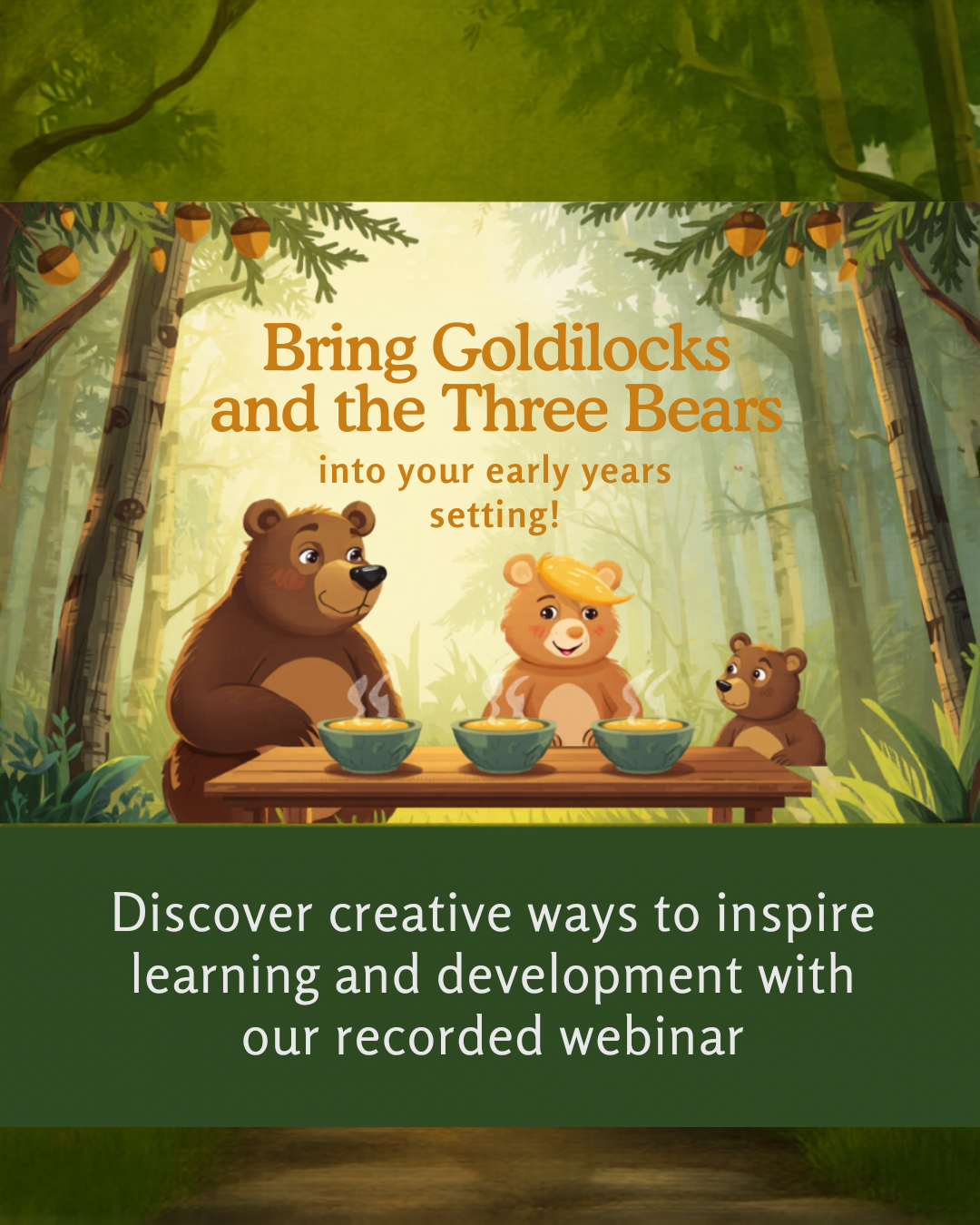
Discover how the classic tale Goldilocks and the Three Bears can be used to support every area of learning and development in the early years. This recorded webinar explores creative, engaging, and imaginative ways to bring the story to life in educational settings. Gain fresh inspiration for storytelling, play, and reflection, while developing new ideas to enhance existing activities and approaches.

Trauma in Early Childhood and Social Development.
We know trauma in Early Childhood (before the age of six) can have huge effects on children’s development and learning. Research has shown the detrimental effect that trauma in Early Childhood can have on brain development. This blog explores the impact that trauma in Early Childhood has on social development in young children and the potential long-term effects of this.
Trauma can be hard to easily define and to think about when it comes to our children, Goldsmith and Turow (2017, p.37) state that, “A common definition of trauma is an overwhelming event or situation that we experience as potentially harmful, that exceeds our coping capacities at the time, and has lasting negative effects.” Examples, of traumatic events are things such as, parental job loss, low income, neglect, physical, emotional and sexual abuse, a horrible one of event such as a car accident, illness, bereavement, rape, poverty, legal difficulties, bullying and so on (Goldsmith and Turow 2017).
Understandably, all of these types of trauma or traumatic events in Early Childhood, are going to have a huge impact on social development. Social development is the development of social skills with others and how we form relationships and friendships with people around us. The ability to form healthy relationships can be affected by our early childhood, past and experiences.
For example, a child who has continuously experienced domestic violence in the home, may be more likely to have outbursts of anger and violence and struggle to know how to play appropriately with other children. This is partly due to the fact that the child has for the majority of their time experienced an unhealthy relationship and doesn’t know what a healthy relationship looks like.
Additionally, due to the traumatic experience of experiencing domestic violence in their early childhood they are in a continuous state of fight or flight. Fight or flight is the physiological feeling/response that we have when we feel anxious or at threat of danger – do we stay and fight it or do we run! Also, other things happen to our bodies when we are in flight or fight, for example, our brain tells our body to release adrenaline and our pulse becomes quicker, there is an increase in respiratory rate and our blood pressure increases, which all sends more oxygen to the brain which increases alertness. Our brain is really clever and when we are feeling at threat of danger, we are actually only using a tiny part of our brain called the Amaygdala. (Nina Venho).
If children are in a continuous state of fight or flight due to a traumatic event, this is going to affect their brain development as well as all areas of development such as social development in early childhood. And research has told us that by the age of only 4 years old children have developed 90% of their adult brain (The National Childhood Traumatic Stress Network). Which is why it is crucial that in early childhood we identify children who have experienced trauma and support them to help reduce the long-lasting effects. As they will not be making healthy connections and building upon the connections between different parts of the brain; while they are experiencing trauma. As well as the effect of the physiological experiences of fight or flight.
Some children and adults as a result of trauma will experience something that is called complex PTSD and attachment trauma. Complex trauma is when someone experiences ongoing traumatic events, such as child abuse or extreme poverty (Schwartz 2019, Goldsmith and Turow 2017). Attachment trauma is often related to child abuse or neglect, Schwartz (2019) states the following:
“Most often there is a combined wound, in which you experience deficient nurturance from loving caregivers coupled with inadequate protection from dangerous situations or people. Growing up within an environment of fear, chaos, or rejection, and abandonment has significant and long-lasting repercussions on physical and emotional health. As a result of attachment trauma, you might carry beliefs that you are damaged, not lovable, or that you cannot trust anyone. You might have feelings of shame, unworthiness, or helplessness. Perhaps, you feel plagued by anxiety or believe that you don’t belong in this world.”
Experiencing Complex PTSD and childhood trauma or attachment trauma, it is going to not only affect children’s current social development in early childhood; but also, may have a long-lasting impact on their social development. It can easily get carried into adulthood and impact their relationships and how they trust and respond to other people; additionally, they may struggle to keep friendships and have a variety of physical and emotional health problems as a result.
As early years professionals we know the importance of developing healthy attachments in early childhood. Children need to have developed a secure attachment by 3 years old (Schwartz 2019) and we will explore in more depth attachment, attachment styles and trauma in another blog post.
To explore childhood trauma more in relation to Covid-19 – click here to join our interactive webinar on 3rd September 2020 at 7:30pm.

The Importance of Language Development for Literacy in Early Childhood.
As a society we have a very heavy misguided emphasis on academic literacy skills in the early years such as can they write their name, can they read a simple word, write a caption, trace letters and form them or match letters (graphemes) to the relevant sounds (phonemes). As parents, carers, early years professionals, teachers, practitioners and managers of settings we feel the pressure to push these literacy skills! Here’s the thing though we need to slow down children need a rich exposure and command of language before we even consider literacy skills such as reading, writing, comprehension and storytelling!
In order to be able to tell a story we first need to have the language to recreate stories, give a narrative, elaborate on our ideas and our thoughts. We can’t tell a story without first developing our understanding of language, developing our listening and attention skills and being able to practise speaking language. Before we are ready to write a story, we need to able to express them in our play, use the narrative as we play with the dinosaurs or make a birthday cake in the role-play area. The richer and more exposure children have to developing language in the early years through play and secure foundations, the better they will achieve later on in school.
Colker (2014) research has shown that there is 30-million-word gap between the wealthiest and poorest families in their study by the age of 3! That is a lot of words that some children have not been exposed to and that lack of vocabulary is going to have an impact on their development. So rather than focusing on literacy skills such as writing, tracing letters (which in my opinion is not literacy – but let’s not go there today!) what we should be focusing on is closing the language gap! Exposing children to more vocabulary, singing a variety of rhymes and songs, exploring and talking alongside our children, reading stories, making up stories, engaging in play, becoming mummy bear or Deno the dinosaur.
In order to be able to understand texts, to read and write segmenting and blending sounds. Children also need the opportunity to first before we even consider this literacy skills, to develop their listening and attention skills and have the opportunity to develop their understanding of vocabulary. We cannot rush children to read, write or develop comprehension before they have the basic skills they need; early childhood is simply not a rush.
Before a child is ready to read words such as b-i-g or c-a-t they need to be able to distinguish the sounds in the words, these means they need to be able to hear the difference to tune into sounds and describe sounds. This tuning into sounds for early phonics learning is done through the environment, musical instruments, body percussion, rhyme and alliteration, not through focusing on writing the word and letters. We need to take it back a step, work on listening and attention with our young children and worry less about the writing and reading.
Also, it is no good a child being able to write or read the words ‘big cat’ if they have no comprehension or meaning of those words, what is big, what is cat? It simply then is nothing but a copying exercise. So, we need to take the time to explore words and meanings alongside children. Talk with our children, set up open ended explorations and play opportunities that are rich in language.
So here is my challenge for you, help develop children’s language development through developing vocabulary, listening skills, opportunities to speak and grow in a language rich environment. I can guarantee this will pay of to helping their literacy skills when they are ready!
Childhood Trauma and Covid-19: Part Three
In part one we explored childhood trauma and the impact of the Covid-19 Pandemic, which will cause some children to experience trauma and Post Traumatic Stress Disorder (PTSD). Although, we do not know the full extent on our children we do know that it is having a profound impact on children’s, mental, physical and social well-being. In part 2 we explored the long-lasting effects of trauma and how it affects development.
Now as early years practitioners and parents we are not therapists, psychologists or psychiatrists. However, we do inform an important support network around the child; which is based in love, care and a nurturing relationship and this cannot be underestimated. We have an invaluable role and are indispensable resources in supporting children in overcoming trauma, PTSD, bereavement, abuse and any other adverse childhood experiences (ACES) they may have. Below in this blog we explore just a few ways that we are able to achieve this.
I am a strong advocate for play in the early years, play is important, it is crucial to child development well-being and learning. It is a widely held theoretical perspective that children learn about the world around them through play and exploration, they make sense of their world around them and they unfold the complexities of the world. I recently read the story of Sandy in the book ‘The boy who was raised as a dog’ by Dr Perry; and this touched me profoundly.
Sandy had witnessed a horrific murder of her mother as well as being attacked herself, she stayed in the house with her dead mothers body for several hours. She tried to wake her up, give her milk which was once comforting and more so drink milk herself which due to her injuries was a horrific ordeal. What struck me though was when she begun therapy with Dr Perry, for weeks and months she acted out this horrific event it was not a one of, she simply did it again and again. This was her way of processing the trauma she had experienced she would get Dr Perry to act out with her pretending to be her mother who was hog tied. This was a brutal enactment that went on for months, but gradually Sandy took more and more control in the situation; until one day she simply said, “we don’t need to do that now let’s have a story!”
I guess this stuck with me because being given this time to role play that situation was important to Sandy, repetitive, child-led and emotionally draining I am sure for both parties. Children who have experienced trauma are going to need uninterrupted time to play, autonomy, careful observation and attempts to understand there play and the opportunity to repeat and repeat as they attempt to understand.
So other than giving children the opportunity to be child-led in play, uninterrupted and have autonomy; how else can we support them with using the power of play? I would suggest small little things that you can do such as introducing mask into the role-play area, having an empty soap pot in your role-play. Setting up tuff trays that look at handwashing in a fun and messy way!
Additionally, consider what Elizabeth Jarman talks about in communication friendly spaces. Children are going to want a small hidden and private space, where they can talk and have the opportunity to explore their trauma. I would highly recommend adding a doll house, or some puppets and just really standing back and listening to what the children are saying, but not interrupting – I am sure it will tell you a lot about their Covid-19 experience.
Another, simple but important thing is to simply reconnect children with nature. We know from research that simply coming into contact with untreated wood, tree trunks and tree stumps; has a positive impact relaxing both body and mind. So, bring wood products into the provision and get outdoors as much as possible. As we discussed in part 2 trauma increases, cortisol in the blood, blood pressure, heart rate and anxiety; whereas extensive research such as that of Miyasaki and forest bathing in Japan has shown that spending just 1 hour outside in nature a day will help to reduce all of these.
Also, there is the practise of mindfulness. Goldsmith Turow (2017) discusses how research was done with Vietnam veterans who were experiencing PTSD and found that by participating in a regular pattern of meditation was beneficial. It helped to develop self-compassion, reduce anxiety and depression, centre people in the now rather then the past, reducing stress and a reduction in feeling overwhelmed and frustrated. There are many ways you can bring mindfulness into the classroom, indoor provision or outdoors; such as guided meditations, taking a moment to consider what all you senses can tell you and how you feel, yoga, acknowledging and giving all feelings spaces and so much more.
Childhood Trauma and COVID-19: Part Two
In the second part of our blog series exploring childhood trauma and the current Covid-19 pandemic. We are going to look at some of the effects of children experiencing trauma on their learning, development and well-being. Some of which can be long-lasting to an individual.
The first few years of a child’s life are unique and special. Understandably trauma experienced in the first 6 years (early years) will have a variety of different effects than that which is experienced by an older child. We know that our brain stores information and experiences both consciously and unconsciously; this will then affect the way that we respond to a situation in order to protect ourselves.
I am currently reading the book ‘The boy who was raised as a dog’ by Perry and Szalavitz (2017) and this notion of association and not being able to regulate or control emotions; is relatable to the story of Sandy; this story sticks predominately in my mind as I think of basing our understandings on experiences, storing them up consciously and unconsciously.
Sandy a little girl who watched the brutal death of her mother at the hand of someone else. The associations the child made, the doorbell that let the killer in, the once safe kitchen knife that slit the child’s throat three times and her mothers throat and the milk she tried to drink for comfort as it spilled from her throat and she tried to give her dead mother. Perry speaks about how no one could understand the outburst of behaviour around milk, the doorbell or kitchen knives; but off course we can look at it knowing her experience and seemingly see the association because we know it. She has associated these 3 things with fear and overwhelming emotion, that she is unable to self-regulate; resulting in uncontrollable outbursts and behaviour.
Sandy was off an age where she was able to communicate to the psychiatrist of what she had seen although young and her experience of that night. However, some children will not have this verbal recall or memory; rather just a fear that is stored in our brain; an association. I remember a child I worked with years ago, we will call him Matthew. Matthew was adopted at the age of 6 months and we as early years practitioners did not know about his early live other then he was adopted; but what we did know was noise was a massive trigger for this boy. When ever there was loud noises as a young baby he would scream and cry and as he turned two, he was prone to outbursts’ and incredibly jumpy and full of fear with loud noises; even those which were familiar. He would often say “noise!” “noise!” as he heard unfamiliar noises the older, he got, he may hide under a table or run to a familiar adult. The point is Matthew didn’t know where that trauma or fear came from, but it was stored inside him and an involuntary response. We suspected that this was the result of a traumatic experience, but we cannot ascertain the exact experience he had within his first few months.
Additionally, we know that the impact of trauma can have a significant impact on children’s brain development. Perry and Szalavitiz (2017) discuss how the most rapid growth of brain development is in the womb and up to the age of 4 where the brain is the most explosive in making new connections and growing. By 4 years old a child has a brain 90% of an adult’s brain, however, this is also when they are the most vulnerable to trauma and neglect. We know that extreme stress or trauma can affect brain development, as children need a nurturing environment to thrive and develop (CDC 2020).
Also, when we experience trauma, we have an alleviated stress level which means that our body produces more cortisol and adrenaline. This is because our bodies are in a continuous state of preparation for fight or flight from situations. This increased rate of cortisol in our blood stream does not only impact on circulation, blood pressure and us in other physical ways; but it also affects the structure of the brain and how it is developed in early childhood. (Perry and Szalavitz 2017 and Goldsmith Turow 2017).
We know that younger children will respond with both physical and psychological responses to traumatic events; as of yet young children have not developed the ability to communicate effectively or regulate their emotions. Often resulting in outbursts and behaviour that is not appropriate or understandable.
Children aged 0-2 exposed to trauma may
Demonstrate poor verbal skills
Exhibit memory problems
Scream or cry excessively
Have poor appetite, low weight, or digestive problems.
Children aged 3-6 exposed to trauma may
Have difficulties focusing or learning in school
Develop learning disabilities
Show poor skill development
Act out in social situations
Imitate the abusive/traumatic event
Be verbally abusive
Be unable to trust others or make friends
Believe they are to blame for the traumatic event
Lack self-confidence
Experience stomach aches or headaches
(The National Child Traumatic Stress Network, 2019)
References:
Goldsmith Turow, R. (2017) mindfulness skills for trauma and ptsd: practices for recovery and resilience. London: W.W. Norton & Company Ltd.
Perry, B.D. and Szalavitz, M. (2017) The Boy Who Was Raised as a Dog: And other Stories from a Child Psychiatrist’s Notebook. What Traumatized Children Can Teach Us About Loss, Love and Healing. New York: Basic Books.
The National Child Traumatic Stress Network, (2017) Early Childhood Trauma [online] https://www.nctsn.org/what-is-child-trauma/trauma-types/early-childhood-trauma [accessed 7.08.2020]
Centers for Disease Control and Prevention (2020) Early Brain Development and Health, [online] https://www.cdc.gov/ncbddd/childdevelopment/early-brain-development.html [accessed 7.8.2020]

Childhood Trauma and the Covid-19 Pandemic: Part One
This blog explores what is trauma and what are children experiencing as a result of the COVID-19 Pandemic.
In light of the current pandemic and uncertainty around COVID-19, social isolation as a result of lock down; we want to discuss recent research by the Childhood Trust (June 2020). Understandably, it has shown that the COVID-19 Pandemic is having adverse effects on children and young people’s mental health. It has stated the following alarming points in regards to children’s health and well-being:
· Children who have an abuser within their household are now in lock down with them, they have no refuge of school and there is an increasing worry of the long-term effect of this as number of referrals drop and early intervention. Simply we have left our vulnerable children more vulnerable and isolated from support networks.
· Alcohol sales in the pandemic have increased by 21% since March and the beginning of lock down. 2.6 million children are living with a hazardous drinker and 705,000 are living with a dependent drinker. This raises alarming concerns around the adverse effects of this increase to our children, the impact of the increased exposure to witnessing drinking patterns and the increase of experience domestic abuse (25-50% of cases involve an abuser drinking).
· There are staggering concerns about those from more disadvantaged backgrounds who may not have access to resources that are needed for remote learning. Therefore, there is an increasing gap, which is called education loss. This could create many problems for children to overcome in order to keep up or close the gap.
· Disclosure of abuse numbers have decreased meaning that many children are dealing with this alone!
· A study of 2000 young people with a history of mental health problems showed 32% agreed that the pandemic had made their mental health a lot worse, while a staggering 51% said as a result their mental health a little worse. This means that 83% of participants have had their mental health affected in a negative way due to the Coronavirus.
· Due to a reduction in services during lock down to support care in the community and health needs, young carers have seen their role in caring increase, this along with it has increased anxiety in this group of children and being a young carer exposes them as more likely to have mental health problems due to the burden of responsibilities they have.
· Mental health support for children being digital and virtual has created many barriers for children such as privacy, increased demand, or ability to participate due to lack of technology. Thus, some children’s care has not continued.
· 2 million children are believed to have experienced hunger since March 23rd 2020!
· Many children live in flats or houses with no access to an outdoor garden, this has had a direct effect on their physical, emotional and social well-being.
(Above information taking from the Childhood Trust, June 2020).
So, with the likelihood that some children their will be trauma and even post-traumatic stress disorder (PTSD) with lasting effects up to 9 years after the end of the pandemic (Childhood Trust, June 2020). To put it quite bluntly some of our children are having a horrific time! Additionally, some children not attending school to them the experience will be almost like a bereavement over the past few months. I know personally after speaking to several parents/carers the impact that the pandemic and lock down has had on their children’s behaviour, mental health, well-being, routines, sense of purpose and has altered the understanding of the world around them.
We feel it is important to consider what the terms trauma and PTSD mean. Goldsmith and Turow (2017, p.37) states that, “A common definition of trauma is an overwhelming event or situation that we experience as potentially harmful, that exceeds our coping capacities at the time, and has lasting negative effects.” When we think of trauma we instantly think of the most horrific events such as war or extreme physical violence; but traumatic events are also things such as bullying or losing a job; and scientific evidence shows that traumatic relations are just as strong for these events as the big stuff we think of (Goldsmith Turow, 2017). In fact, when you think about trauma in these terms then we realise that actually in our life time we actually experience many different traumatic events.
It is worth noting that there are a variety of factors that will influence the impact of trauma and no two people will respond the same. For example, something that may become a traumatic experience for me, someone with a different, character, personality, social background, beliefs, economic status, other life experiences and so on; may have developed more of a resilience to the situation and it might not affect them in an adverse way. For that very reason everyone’s response to trauma will be different from a subtle response to a life-changing response to a situation. (SAMSA 2014).
PTSD is slightly more complex than our responses to trauma and often has a long-lasting effect. PTSD is a mental health condition that is classed as an anxiety disorder, which develops from people’s experiences of traumatic events or situations. It is estimated that 1 in 3 people who experience trauma are likely to develop PTSD. (NHS UK, 2018).
In our next blog we will explore how trauma affects development and learning but also the lifelong impacts that trauma has on children. In our third blog we are going to support children in processing the trauma they have experienced.
References:
The Childhood Trust (2020) Children in Lockdown: The Consequences of the Coronavirus for Children Living in Poverty. [accessed on 28/07/2020] Available at:
Goldsmith Turow, R. (2017) mindfulness skills for trauma and ptsd: practices for recovery and resilience. London: W.W. Norton & Company Ltd.
NHS UK (2018) Post Traumatic Stress Disorder [accessed on 28/07/2020] Available at:
https://www.nhs.uk/conditions/post-traumatic-stress-disorder-ptsd/
SAMSA (2014) A Treatment Improved Protocal: Trauma-Informed Care in Behavioural Health Services [accessed on 28/07/2020] Available at:
https://www.ncbi.nlm.nih.gov/books/NBK207201/pdf/Bookshelf_NBK207201.pdf
The Nature Challenge
It all begins with an idea.
Since beginning my forest school training, I have become very interested in the role that nature has to well-being. In fact, I have probably become a bit obsessed over it, I completely utterly fascinated by all of the benefits of nature and some of the research that is being produced and discussed. I am currently reading ‘the nature fix by Florence Williams’ which I highly recommend to anyone that is interested.
Also, whilst experiencing the current pandemic of Covid-19 I am sure that we are all feeling in different ways the impact on our well-being. So now more then ever I think is the time to explore the link between nature and our well-being.
So, let’s just look at one example, in Japan people regularly participate in something that is called Shinrin-yoku (which is the Japanese way of forest bathing). Studies by Professor Yoshifumi Miyazaki have shown some interesting finds and things to consider. Such as in their laboratory studies they found that people that came into direct contact with wood, touching the tree trunk, smell and so on, meant that participants brains and bodies became more relaxed. This also includes natural untreated wooden items in our home or settings. (Yoshifumi Miyazaki 2018)
Furthermore, an experiment across 63 forests in Japan and 756 participants found the effect of forest bathing or being outside in nature was the following:
A decrease in sympathetic nerve activity (known to increase during times of stress).
A decrease in blood pressure.
A decrease in pulse rate.
A decrease in concentration of the stress hormone cortisol.
(Yoshifumi Miyazaki, 2018 page 146) If this was not enough reasons to head for outside participants also reported after joining in forest therapy a sense of difference to their well-being through feeling physiologically relaxed, as well as feeling calm, refreshed, less anxious and experiencing a better emotional state (Yoshifumi Miyazaki 2018)!
So, here is our nature challenge for a week, spending just 30 minutes outside is said to improve our well-being.
Day One: I’m going on a colour hunt…
Nature is beaming with all sorts of colours. Take a little basket or container and see how many colours you can find. Can you find all the colours of the rainbow? When you get home, make a rainbow and display it in your window for everyone to see.
Day Two: Dandelion playdough:
Go for a walk and collect a generous handful of dandelions on your way. When you get home work together to make some lovely smelling Dandelion playdough.
Ingredients:
A generous handful of dandelions
2 cups of flour
1 cup of salt
1 cup of boiling water
1 tbsp of oil
1 tsp of cream of tartar
Step one:
Put the dandelions in the water and blend together with a hand blender.
Step Two:
Mix the flour, salt, oil and cream of tartar in a bowl.
Step Three:
Slowly add the dandelion water mix, stirring as you go.
Step Four:
Knead it together into a dough.
Day Three: Hapa Zome (Hammer Art)
This is a great activity for not only being creative and connecting with nature, but also supporting children’s hand-eye coordination. Their ability to use tools safely and with control. To be able to look closely, develop curiosity about details such as veins and lines, too begin to notice symmetry and patterns in nature. All you need to do is find some different leaves or petals. You need a piece of white cotton or linen that you fold in half to pop your finds in. Make sure that you lay them flat and on a flat surface, use a hammer and bang the cotton. Gently pull the cotton apart and voila you have a lovely nature print.
Day Four: Colourful Crowns
Go for a walk or into the garden and see what lovely colours you can collect to make a beautiful colourful crown, fit for a prince or princess. Simply cut a strip of card that will fit around the child’s head and stick your different coloured treasures that you find onto it.
Day Five: Ice Garden
Find some petals or leaves in the garden or on a walk and collect them into a little plastic pot that can go in the freezer. Arrange the items how you would like them and place a piece of looped string in. Half fill in water and make sure that some of the loop of the string is out of the water. Pop in the freezer for a few hours. Top up with some more petals/leaves and water and put back in the freezer (again making sure that some of the string is out of the ice). When it is completely frozen hand from a branch and watch them melt.
Day Six: Forest Bathing
Go to your local woods and go for a mindfulness walk, take your time do not rush use all of your senses. What can you see, smell, taste, hear and touch? Find somewhere quiet to sit, close your eyes and feel the wind or sun on your face, what does the ground below you feel like? Or the tree trunk you lean against?
Day Seven: Nature Aliens
Collect different natural items of the floor on your walk (don’t pick) such as pine cones, petals and leaves. When you have collected lots of goodies, have a challenge to see who can make the scariest alien!