Blog post two in our series of exploring the voice of the child, is on the topic of why is the voice of the child in the early years important. In recent years with the previous Ofsted framework having a focus intent, implementation and impact, we have talked a lot about the why. Understanding our why or intent – can help us to ensure that our practice in the early years is grounded in understanding and knowledge of child development and good practice. The 3 I’s may not be such a focus of the new early years’ inspection toolkit, but there is still a strong need of understanding why we do what we do – regardless of the terminology we are using. So why is valuing the voice of the child important?
Listening to the voice of the child and valuing it in early years has several healthy benefits from boosting children’s self-confidence and self-image, too empowering and giving children autonomy. It helps us to understand them and their perspectives and lead to better decision making. We may have heard the phrase, “Oh, I wish to see the world through a child’s eyes again”. It is often a perspective that is romanticised, with the idea of looking at the world for the first time with awe and wonder and magic. Some of which is true, when we truly begin to see the world from the perspective of a 3-year-old again, we might see magic and wonder all around us. But we also might suddenly understand the challenges they are facing, the things that confuse them and their wants and desires.
By taking the time to understand and truly listen to their perspectives; it can help us to involve children in decision-making. When we involve children in decision-making it helps to give them a sense of control and autonomy; rather than seeing the world as something that is happening to them, it helps to involve them in that world. We know that children who are empowered and autonomy; will develop more resilience, there will have high levels of well-being and increased self-confidence. When children are empowered to use their voice, they flourish, they are more engaged in their learning and they achieve better academically. Part of these higher levels of engagement through valuing the voice of the child, results in higher levels of motivation. Motivation cannot be underestimated and is powerful when we are working with others.
Additionally, in terms of the Early Years Foundation Stage (EYFS) we have the overarching principle of the Unique Child. Tailoring our practice, curriculum, teaching, environment and positive relationships to the individual needs of the children. Understanding that all children are different, have different experiences, different interests and stages of development; but all are wonderful and unique. If we truly want to meet the needs of the unique child in our early year’s settings, we cannot avoid the most powerful thing – the voice of the child.
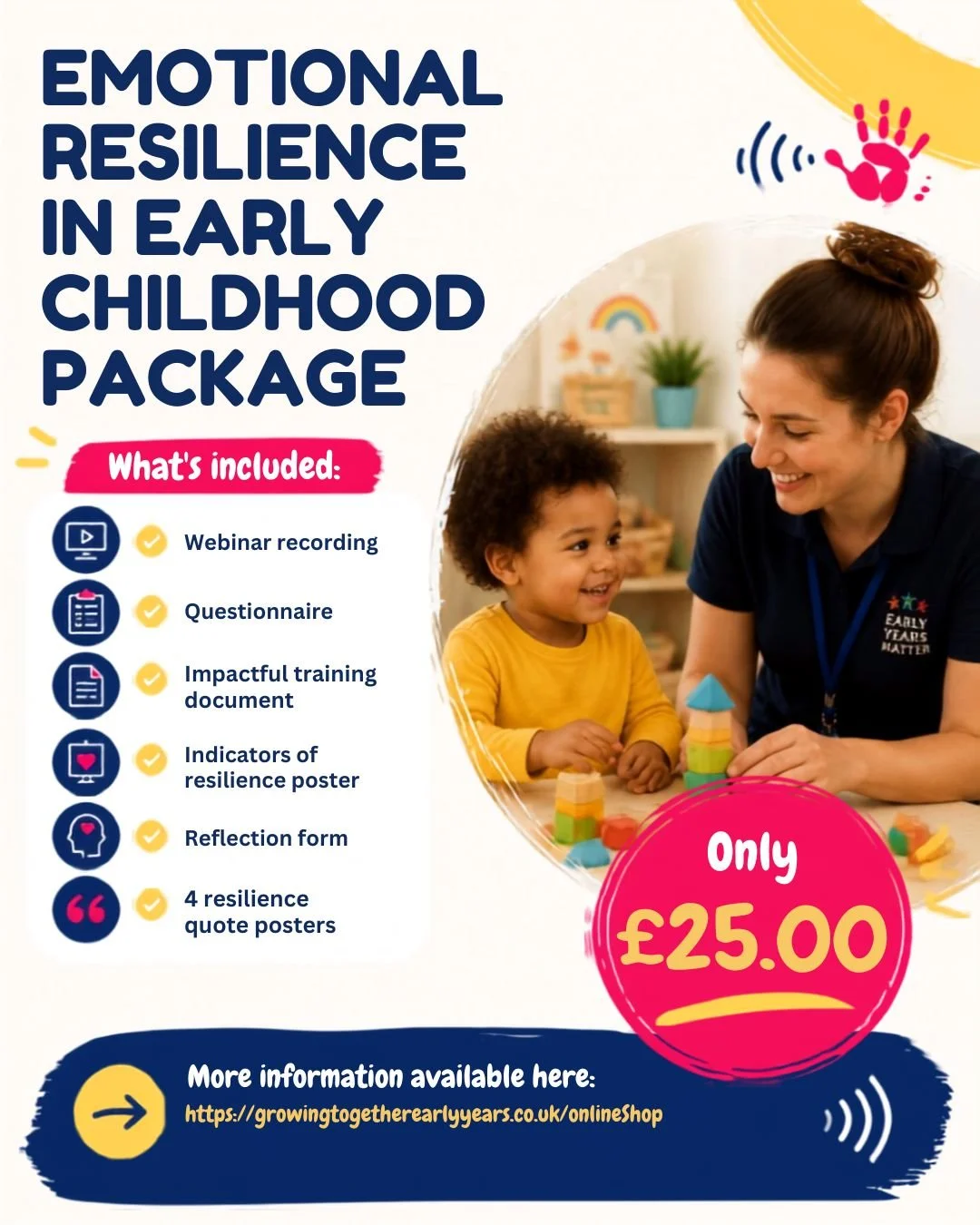
In an ever-changing world we want to see a future generation who have resilience in the face of uncertain circumstances. This package contains several resources for practitioners working in the early years explores what we mean by the term resilience, current research on resilience in early childhood and how as professionals we can support children to develop resilience. As well as making impactful changes to our settings and practise to support the resilience of the setting.
The package includes the following:
Recording of our webinar ‘Emotional Resilience in Early Childhood’ and accompanying PowerPoint presentation.
A certificate to say that you have watched the recording to add to your CPD file.
Emotional resilience in childhood questionnaire.
Impactful training document - allowing individuals to reflect on the webinar and make sure it is impactful to their setting.
Indicators of resilience poster in both pdf and png format.
Resilience intent, implementation and impact reflection form.
4 resilience quote posters in both pdf and png format.