
The Leader You Are Every Day: How Small Actions Shape Big Outcomes in Early Years Practice
Leadership in early years rarely feels like the job description suggests. It isn’t a neat list of competencies, nor a tidy framework you can pull out in a staff meeting. More often, it feels like juggling: supporting a practitioner who’s had a difficult morning, responding to a parent who needs reassurance, protecting the integrity of your curriculum, and still finding a moment to breathe before lunchtime.
But here’s the truth we don’t say often enough: Leadership is not the big moments. It’s the small ones. It’s the everyday behaviours. The tone you use, the curiosity you model, the calm you hold, the values you make visible — that quietly shape the culture, confidence, and quality of your setting.
In early years, leadership is lived practice.
Leadership as a pedagogical act
We often talk about pedagogy in the simplest terms as “the art of teaching”. In other terms pedagogy could be something practitioners refer to as the “approach and how we teach”, but leadership is deeply pedagogical too. Every decision you make teaches something: about what you value, what you prioritise, and how you want your team to think about children’s learning.
When you protect time for reflection, you teach your team that thinking is part of practice. When you ask, “What did you notice?” instead of “Did you finish?”, you teach that observation matters. When you slow down to model curiosity, you teach that learning is relational, not rushed; you value the time for critical thinking in learning.
Competitor content often frames leadership as strategic planning, compliance management, or operational oversight. Those things matter, but they don’t tell leaders what to do tomorrow morning. Growing Together’s approach is different: leadership is something you enact in the moment, with intention and humanity.
The emotional climate starts with you
Early years settings are emotional ecosystems. Children feel the room. Staff feel the room. And leaders, whether they intend to or not — set the emotional temperature.
This doesn’t mean leaders must be endlessly calm or endlessly positive. It means they are emotionally aware. They notice when a practitioner is carrying something heavy. They recognise when the team needs grounding rather than motivation. They understand that psychological safety is not a “nice to have”; it is the foundation of high‑quality practice.
A leader who says, “Let’s pause and think together,” creates safety. A leader who listens before advising creates trust. A leader who models emotional regulation teaches the team how to support children to do the same.
These are not grand gestures. They are micro‑moments, but they accumulate.
Culture is built in the small decisions
Culture is often described as “the way we do things around here”, but in early years it’s more precise: Culture is the sum of your everyday leadership behaviours.
It’s built when you:
choose reflection over reaction
hold boundaries with kindness
make values visible in your decisions
ask questions that deepen thinking
protect time for practice quality, even when the day is busy
These actions tell your team what matters. They show them how to think, how to collaborate, and how to hold children at the centre of every choice.
Culture isn’t created in away days or strategy documents. It’s created in the corridor conversations, the shared problem‑solving, the way you respond when something goes wrong.
Leadership that shapes children’s experiences
It’s easy to forget that leadership reaches children indirectly but powerfully. When leaders create a reflective, emotionally safe, values‑led environment, children experience:
calmer adults
more intentional interactions
richer learning conversations
more consistent boundaries
a curriculum that is lived, not laminated
Your leadership shapes the climate children grow in. Not through the policies you write, but through the behaviours you model.
A more human way to lead
The early years sector is full of frameworks, competencies, and leadership models. They have value — but they often miss the heart of the work.
Growing Together champions a different view: Leadership is relational. Leadership is reflective. Leadership is pedagogical. Leadership is human.
And because it is human, it is built in the small moments. The ones that don’t make it into job descriptions but make all the difference in practice.
A reflection to close
Tomorrow, notice one leadership behaviour you enact and a question you ask, a tone you choose, a moment you pause, a value you make visible.
Ask yourself: What did this teach my team? What did this make possible for children?
Leadership is not who you are in the big moments. It’s who you are every day.
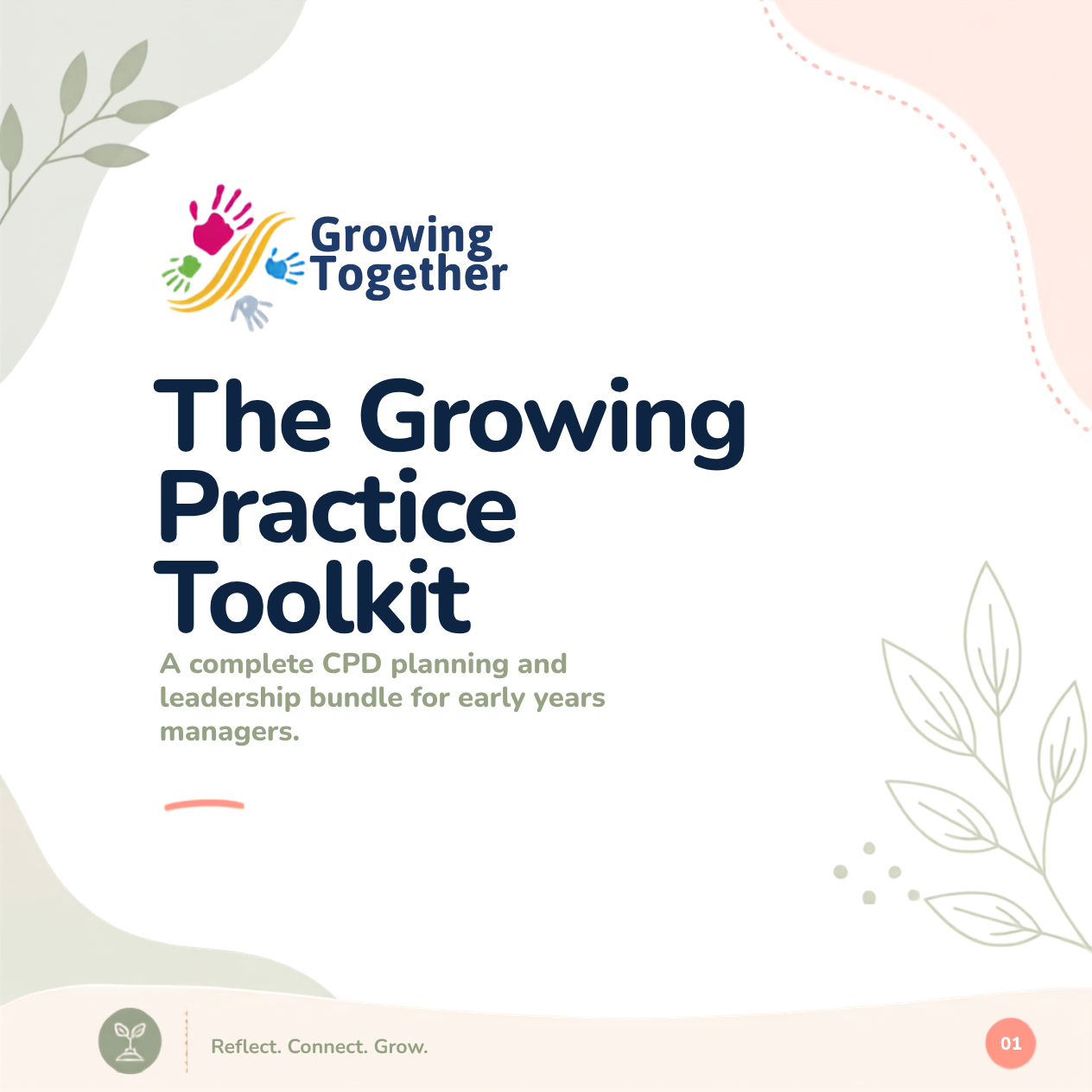
A complete CPD planning and leadership bundle for early years managers.
The Growing Practice Toolkit brings together four beautifully designed, practical resources that help managers plan CPD with confidence, clarity, and intention. Instead of scrambling for courses or filling a calendar for the sake of it, this toolkit supports you to build CPD around what children need, what your team needs, and what your setting is working towards.
Inside the toolkit, you’ll find:
CPD Planning Templates for setting‑level and individual development
A Supervision Conversation Guide that supports reflective, strengths‑based discussions
A Seasonal CPD Calendar aligned to the natural rhythm of the early years
A Reflective Leadership Exercise that helps you identify meaningful CPD priorities
This bundle is perfect for managers who want CPD to feel purposeful, relational, and achievable — not overwhelming. It’s a calm, structured way to grow your team, strengthen practice, and create a culture where learning becomes part of everyday life.