
There’s a moment in every early years manager’s year when CPD planning lands on the to‑do list. Sometimes it arrives gently — a reminder that the new term is coming. Other times it arrives with a thud, usually accompanied by a sense that you “should” already have a plan in place.
But here’s the truth: CPD isn’t a calendar you fill. It’s a culture you grow.
When we talk to managers, they often describe CPD as something they organise — training days, courses, staff meetings. Yet the most meaningful CPD doesn’t start with a course. It starts with a question:
What do children need from us right now?
That question is the heart of CPD planning. And when you build your plan around it, everything becomes clearer — for you, for your team, and for the children who feel the impact of confident, reflective adults every single day.
CPD begins with the setting
Before you think about individual practitioners, pause and look at the setting as a whole. What’s happening in the rooms? What’s happening in the garden? What’s happening in the tiny moments between adults and children?
Often, the clues are subtle:
A group of children struggling with turn‑taking
Practitioners feeling unsure about sensory needs
Interactions that are warm but not always intentional
Environments that feel a little tired or not quite supporting communication
These small signals tell you far more than any checklist ever could. They help you identify one or two themes that genuinely matter this year — not ten, not twelve. Just the ones that will make the biggest difference.
When CPD is rooted in what children are showing you, it becomes purposeful. It becomes child‑led. And it becomes far easier to plan.
Then, turn towards your team
Once you’ve identified your setting priorities, shift your attention to the individuals who bring your environment to life.
Every practitioner has a different starting point. Some brim with confidence in certain areas. Others quietly carry worries they’ve never voiced. Some are ready to stretch into new responsibilities. Others need reassurance that they’re already doing well.
Supervision is your best friend here. Not the rushed version squeezed between other tasks — but the kind where you sit down, breathe, and really listen.
Ask:
What feels strong in your practice right now?
What feels wobbly?
What would you love to grow in this year?
What support would help you feel more confident?
People grow when they feel seen. CPD is one of the most powerful ways to show that.
Link their personal goals to the setting priorities, but keep them individual. Two practitioners may share the same CPD theme, yet need completely different approaches.
A simple, CPD framework
You don’t need a complicated system. You need a clear, human one.
Setting-Level CPD
Choose 1–2 priorities for the year. For each one, explore:
What children need
What the team needs
What success looks like
How you’ll revisit learning
Individual CPD
For each practitioner:
Identify a strength
Identify a development focus
Link it to the setting priority
Plan small, achievable actions
Agree a follow‑up point
Small, consistent learning beats big, infrequent training days. It’s the everyday conversations, the coaching moments, the shared reflections that change practice.
Making CPD stick
This is the part managers often worry about. Embedding learning so it doesn’t fade after the training day.
CPD sticks when it becomes part of your rhythm:
You revisit it in team meetings
You talk about it during supervision
You coach it in the moment
You celebrate small wins
You create space for reflection
Learning becomes part of your culture when it becomes part of your conversations.
What this looks like in practice
Communication & language priority
A whole‑team focus on high‑quality interactions. Individual goals might include:
Narrating play with confidence
Extending conversations beyond one turn
Supporting EAL learners with intentional language modelling
SEND confidence priority
A setting focus on early identification and responsive environments. Individual goals might include:
Adapting sensory spaces
Supporting transitions
Using observation tools confidently
Behaviour as communication priority
A setting focus on co‑regulation and emotional literacy. Individual goals might include:
Supporting big feelings
Modelling calm-down strategies
Building emotional vocabulary
CPD planning is one of the most impactful things you do as a leader. When it’s intentional, it strengthens practice, builds confidence, and improves children’s experiences.
It doesn’t need to be perfect. It simply needs to be thoughtful.
When your team grows, your setting grows. And children feel the difference.
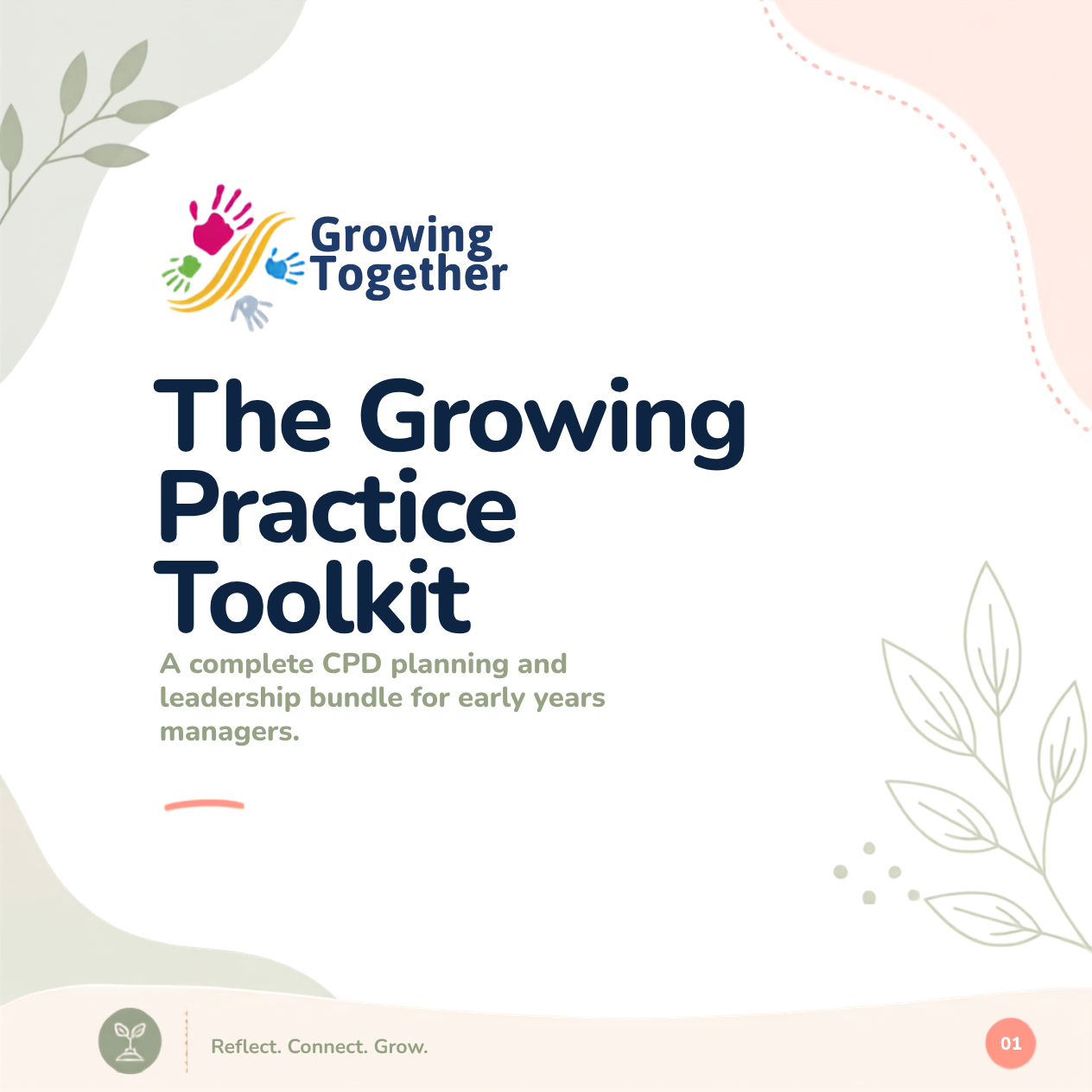
A complete CPD planning and leadership bundle for early years managers.
The Growing Practice Toolkit brings together four beautifully designed, practical resources that help managers plan CPD with confidence, clarity, and intention. Instead of scrambling for courses or filling a calendar for the sake of it, this toolkit supports you to build CPD around what children need, what your team needs, and what your setting is working towards.
Inside the toolkit, you’ll find:
CPD Planning Templates for setting‑level and individual development
A Supervision Conversation Guide that supports reflective, strengths‑based discussions
A Seasonal CPD Calendar aligned to the natural rhythm of the early years
A Reflective Leadership Exercise that helps you identify meaningful CPD priorities
This bundle is perfect for managers who want CPD to feel purposeful, relational, and achievable — not overwhelming. It’s a calm, structured way to grow your team, strengthen practice, and create a culture where learning becomes part of everyday life.